Tools & materials you'll need
Affiliate linksAs an Amazon Associate FixlyGuide earns from qualifying purchases — at no extra cost to you. Prices and availability are accurate as of publication and subject to change.
Quick Answer
The most significant dishwasher mistake homeowners make is diligently pre-rinsing their dishes before loading them into the machine. While this seems like a helpful step, it directly undermines how modern dishwashers and detergents are engineered to work. Your dishwasher's detergent contains enzymes that need food particles to break down; without them, the harsh chemicals can permanently etch your glassware, leaving it cloudy. Furthermore, your dishwasher's automatic sensors detect rinsed dishes as "clean," prompting a shorter, lighter wash cycle that isn't powerful enough to flush out grime and can lead to a buildup of residue in your filter and pump, causing damage and shortening the appliance's lifespan.
The Problem
You follow all the rules. You rinse every plate, load the dishwasher carefully, and use a quality detergent. Yet, you’re facing a frustrating set of problems. Your glasses emerge with a permanent, milky cloudiness that no amount of scrubbing can remove. You pull out a bowl that supposedly just went through a full wash cycle, only to find a piece of last night's dinner still stuck to it. And lately, a faint, foul odor greets you every time you open the dishwasher door, even when it’s full of "clean" dishes.
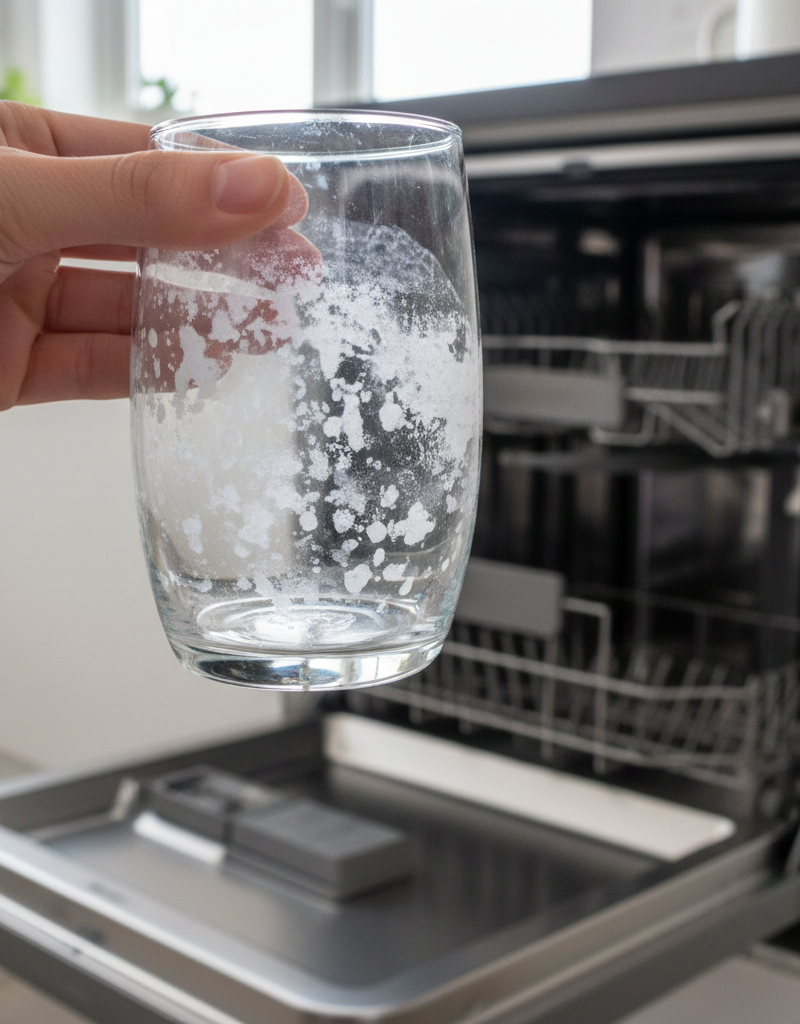
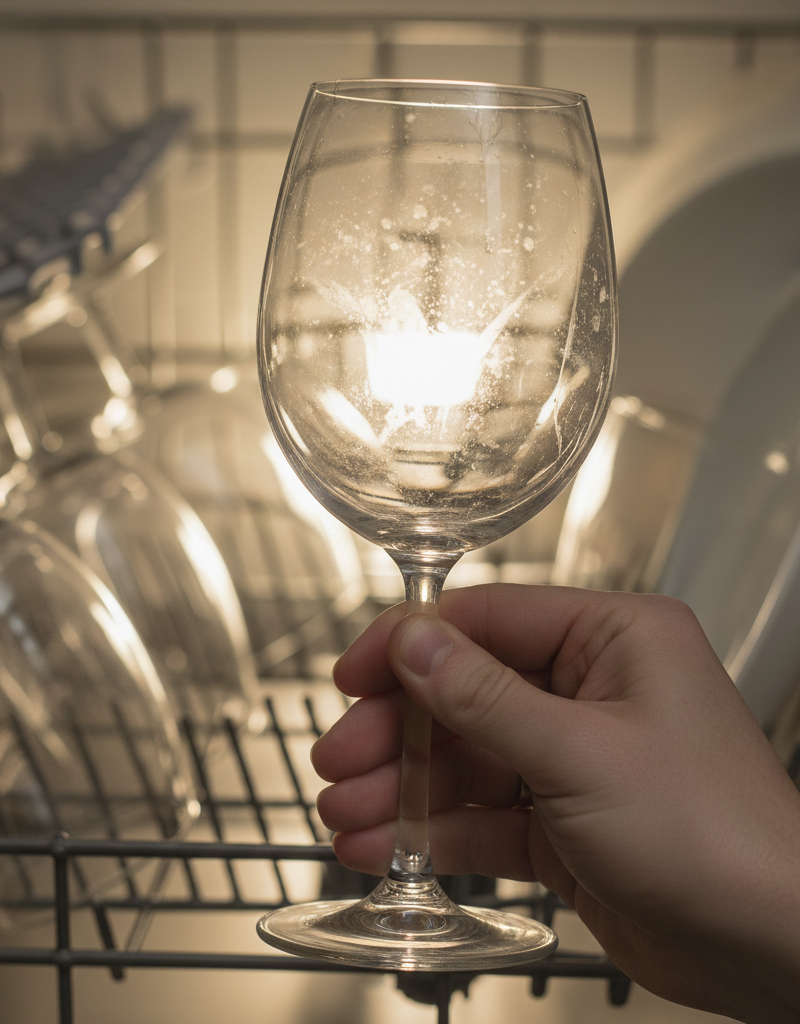
These aren't signs that your dishwasher is simply old or failing. These are classic symptoms of a system being undermined by one single, counter-intuitive habit: pre-rinsing. By washing the food off the plates yourself, you are inadvertently creating a cascade of failures. The cloudy glassware is etching—permanent, microscopic damage caused by detergent that has no food to attack. The leftover food particles are the result of the dishwasher running a light cycle because its sensors were fooled into thinking the dishes were already clean. This weaker cycle lacks the force to dislodge and flush stubborn or hidden food debris, which then gets recirculated and deposited elsewhere. That foul odor? It’s from the food particles and grease that the weak wash cycle failed to flush, now slowly decomposing in your filter, drain hose, and sump, creating a breeding ground for bacteria.
Ultimately, this single mistake puts immense strain on your machine. The pump has to work harder to circulate water through a progressively clogging filter, and the entire system becomes less efficient, leading to more frequent repairs and a lifespan that can be cut short by years.
How It Works
To understand why pre-rinsing is so detrimental, you need to look at the two key technologies inside every modern dishwasher: soil sensors and enzymatic detergents. These systems work in tandem and rely on dirty dishes to function properly.
First is the soil sensor, often called a turbidity sensor. This is a small but brilliant piece of technology usually located in the sump area at the bottom of the dishwasher tub. During the initial pre-wash or sensing phase of a cycle, the sensor shines a small beam of infrared light through a water sample drawn from the tub. A sensor on the other side measures how much of that light passes through. If the water is full of food particles (very turbid), the light will be scattered and diffused, and the sensor will detect a low level of light. This reading tells the dishwasher's main control board, "This is a heavily soiled load!" In response, the dishwasher unleashes its most powerful, longest, and hottest cycle to ensure everything comes out clean. Conversely, if you pre-rinse, the water in the tub is mostly clear. The light beam passes through with little interference, and the sensor tells the control board, "This load is already clean." The dishwasher then defaults to a shorter, lower-temperature "eco" or "light" wash, which uses less water and energy but lacks the hydraulic force and heat needed to thoroughly clean and, critically, to flush itself.
Second is the formula of your detergent. For the past two decades, nearly all dishwasher detergents have been enzymatic. They contain biological enzymes, primarily amylase (to break down starches like potato and rice) and protease (to break down proteins like egg and meat). These enzymes function like a lock and key; they are designed to latch onto and dismantle specific food molecules. When you put scraped—but not rinsed—dishes into the machine, you’re giving these enzymes their intended fuel. They go to work neutralizing food soils. When you pre-rinse, you starve them. The enzymes find no food to digest, but the cycle still runs. The detergent's other powerful chemical components, like bleach and builders (alkaline salts), which are meant to be buffered by the food, are now free to attack the most vulnerable surfaces available: the silicate in your glassware. This repeated chemical assault microscopically erodes the glass surface, creating what we see as permanent cloudiness, or etching.
Step-by-Step Fix
Correcting this dishwasher mistake involves un-learning an old habit and performing a deep clean to reset your machine's performance. Follow these steps to restore your dishwasher's cleaning power and protect your dishes.
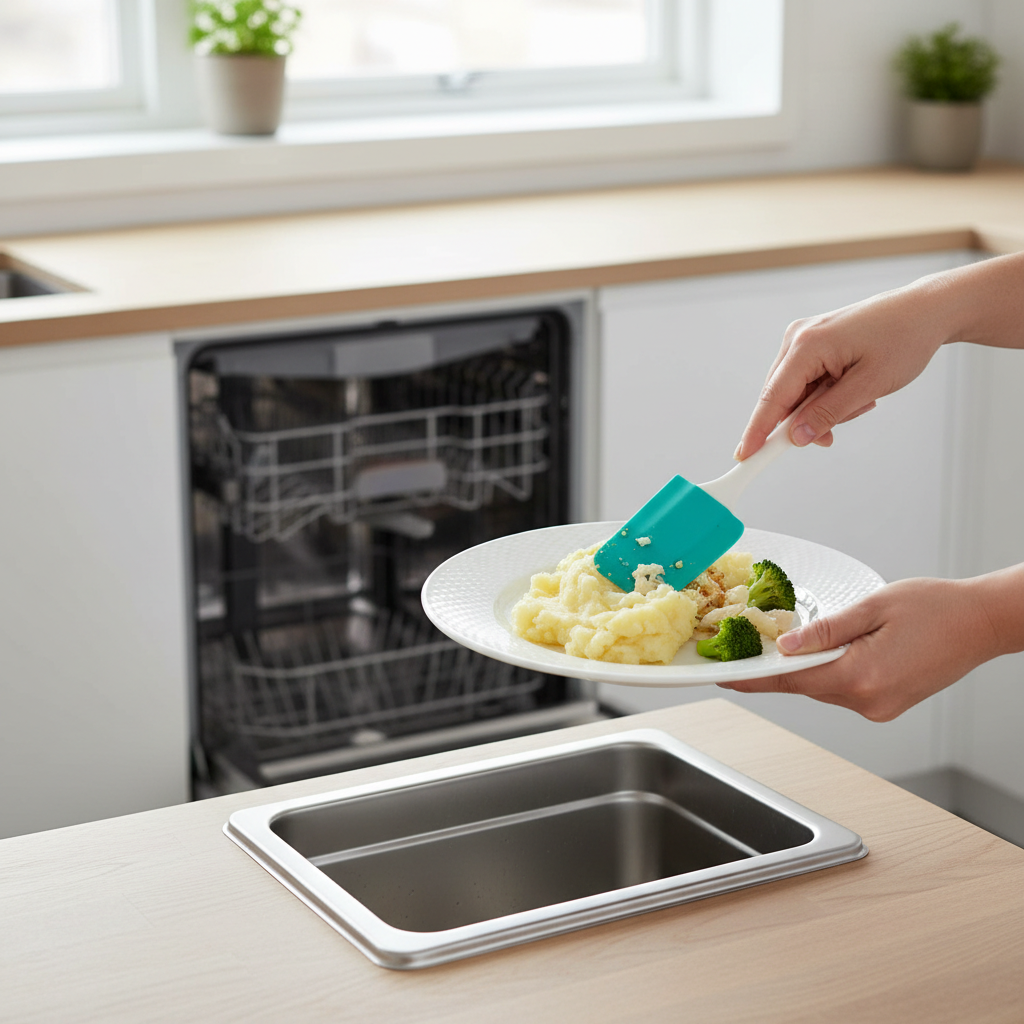
1. Stop Pre-Rinsing, Start Scraping — The most important step is to change your habit immediately. Instead of rinsing dishes under the tap, use a spatula, spoon, or paper towel to scrape solid food chunks into the trash or compost. Sauces, oils, crumbs, and residues should be left on the plate. This gives the detergent its necessary fuel and ensures the soil sensor gets an accurate reading.
2. Locate and Deep Clean the Filter — Your dishwasher's filter is the component that has suffered most. It’s almost certainly clogged. Open your dishwasher and remove the bottom rack. Look for a cylindrical component, usually with a coarse and fine mesh screen, in the floor of the tub. Twist to unlock it (often marked with arrows) and pull it out. Take the filter assembly to the sink and wash it thoroughly with an old toothbrush and hot, soapy water until all food residue and greasy film are gone. Rinse and reinstall it.
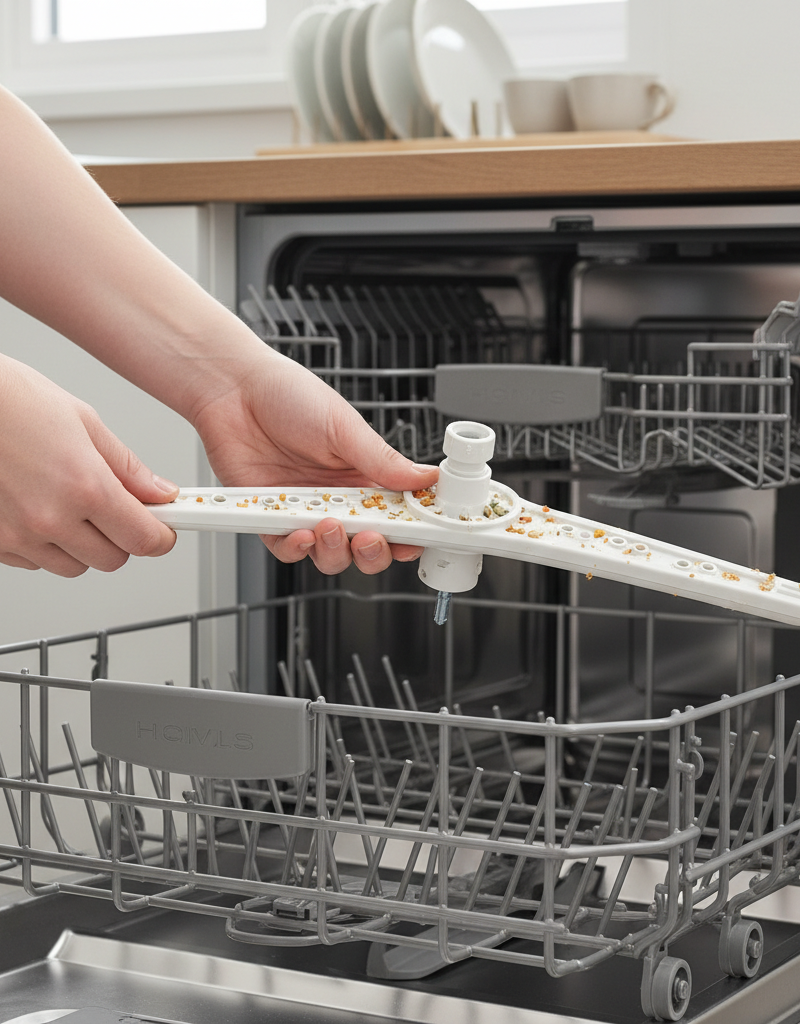
3. Inspect and Unclog Spray Arm Nozzles — The weak wash cycles may have allowed small particles to become lodged in the spray arm nozzles, blocking water flow. The spray arms are the spinning bars that spray water onto the dishes. Most can be removed by simply pulling them up or unscrewing a central retaining nut. Once removed, inspect the tiny holes. Use a toothpick, a straightened paperclip, or a pair of needle-nose pliers to gently poke out any visible debris. Rinse the arms under your sink faucet to flush out any newly dislodged gunk before re-installing.
4. Load for Maximum Water Coverage — Proper loading is critical now that you are leaving food residue on the dishes. Place dirtier items on the bottom rack, facing the spray arm. Angle plates, bowls, and platters inward and downward. Don't let large pans or cutting boards block the spray arm's path or the detergent dispenser. Ensure items aren't nesting together, which prevents water and detergent from reaching the surfaces.
5. Run a "Purge" Cycle with a Cleaner — To eliminate the built-up grease, bacteria, and mineral deposits from inside the machine's plumbing, you need to run a cleaning cycle. Purchase a dedicated dishwasher cleaning product, such as Affresh, Finish, or Glisten. Follow the package directions, which usually involve placing a tablet or a bottle of solution into an otherwise empty dishwasher and running it on its hottest, longest cycle (often "Heavy" or "Pots & Pans").
6. Verify Your Hot Water Temperature — Dishwasher detergents work best in water that is at least 120°F (49°C). If your home's hot water heater is set too low for efficiency, it can hinder performance. Turn on the hot water tap at the sink nearest the dishwasher. Let it run for a minute until it’s as hot as it will get, then capture some in a meat or beverage thermometer. If it’s below 120°F, consider turning your water heater up slightly. Most are set to 120°F by default, but some may be lower.
7. Refill the Rinse Aid Dispenser — Rinse aid is not a marketing gimmick; it's essential for modern dishwashers. It contains surfactants that reduce the surface tension of water. This prevents water from forming droplets on your dishes during the final rinse, which would otherwise leave spots as they dry. Instead, the water sheets off, resulting in dramatically better drying and shinier dishes. This is especially important for plastics.
8. Select the "Auto" or "Normal" Cycle — With your newfound habit of scraping, not rinsing, trust your machine. The "Auto" or "Normal" cycle is now your best friend. The dishwasher will use its soil sensor to determine the exact cycle time and temperature needed for a perfect clean. Avoid the "Light" or "Eco" settings unless you truly have a load of very lightly soiled items like coffee mugs.
Common Causes
The habit of pre-rinsing dishes is deeply ingrained in many households, often for logical-seeming reasons that are now obsolete. Understanding why you do it is the first step to changing the behavior.
- Generational Habit: For decades, dishwashers were much simpler, less powerful machines. They lacked sophisticated filters and sensors. For users of dishwashers from the 1970s through the early 1990s, pre-rinsing was not a mistake; it was a requirement to prevent a messy, clogged machine. Many of us were taught this method by parents or grandparents and never had a reason to question it.
- Fear of Clogs: Homeowners are rightly afraid of clogged drains and broken appliances. The idea of putting plates with visible food residue and sauces into a complex machine seems like an invitation for disaster. It feels intuitive to wash away the "big stuff" to prevent a future plumbing headache, without realizing that the machine is designed to pulverize and flush precisely that material.
- A "Smelly Dishwasher" Problem: If a dishwasher starts to smell, often due to a clogged filter, the user's first instinct is to blame the food being put inside. They begin rinsing dishes more thoroughly to combat the smell, believing less food will solve the problem. In reality, they are exacerbating the issue by causing the machine to run weaker cycles, which allows more food to get trapped and decay in the filter.
- Misinterpreting "Scrape Dishes" Instructions: Many dishwasher manuals state, "There is no need to rinse dishes. Just scrape off large food particles." Some users interpret "large food particles" as any visible food, leading them to rinse off sauces, crumbs, and residues that should be left on.
Common Mistakes
Beyond pre-rinsing, several other common mistakes can degrade your dishwasher's performance and longevity. Avoid these pitfalls:
- Overloading and Nesting: Jamming too many dishes into the machine or allowing bowls and spoons to "nest" together creates impenetrable barriers. Water and detergent can't reach these surfaces, resulting in dirty dishes. Give items space.
- Blocking the Spray Arms: Placing a tall baking sheet or a large pot in a way that physically blocks the rotation of the upper or lower spray arm is a frequent error. If the arm can't spin, half the dishes won't get washed. Give it a gentle spin by hand before starting a cycle to ensure it has clearance.
- Using Too Much or the Wrong Detergent: More is not better. Using too much detergent, especially with soft water, can leave a chalky film and contribute to etching. Stick to the manufacturer's recommended amount. Also, never substitute regular dish soap for dishwasher detergent; it will create a mountain of suds that will pour out of the machine and can damage the pump.
- Ignoring the Filter Indefinitely: The single most important maintenance task is cleaning the filter. Many dishwasher owners don't even know it exists. An ignored, clogged filter is the #1 cause of poor cleaning performance, bad smells, and strain on the circulation pump.
- Washing Non-Dishwasher-Safe Items: Putting items like soft plastics, insulated mugs, good kitchen knives, wooden cutting boards, or cast iron cookware in the dishwasher can ruin the item and, in some cases, the machine. Wood can warp and splinter, plastics can melt and fall onto the heating element, and harsh detergents will strip the seasoning from cast iron and dull knife blades.
Cost & Time Breakdown
Failing to correct the pre-rinsing mistake can lead to component failures and the need to replace ruined dishes. This table breaks down the potential costs of service and replacement parts compared to the simple DIY fixes.
| Task | DIY Cost | Pro Cost | Time Involved |
|---|---|---|---|
| Replace Etched & Cloudy Glassware | $50 - $200 | N/A | 1-2 hours (shopping) |
| Replace Clogged Upper/Lower Spray Arms | $30 - $75 | $150 - $250 | 30 minutes |
| Clear a Severely Clogged Drain Line/Pump | $10 - $20 (tools/cleaners) | $175 - $350 | 2 hours |
| Replace a Failed Circulation Pump/Motor | $150 - $300 (part only) | $450 - $700+ | 3-4 hours |
| Replace a Faulty Soil/Turbidity Sensor | $40 - $90 (part only) | $200 - $350 | 1-2 hours |
| Routine Filter & Spray Arm Cleaning | $0 | N/A | 5 minutes/month |
Tips & Prevention
Keep your dishwasher running flawlessly for years and your dishes sparkling with these preventative habits.
- Scrape, Don't Rinse: This is the golden rule. Scrape solid food into the trash. Let the dishwasher and detergent handle the rest.
- Clean Your Filter Bi-Weekly: For an average family, a quick rinse-and-scrub of the dishwasher filter every two weeks is the best defense against grime, odors, and poor performance. Set a recurring calendar reminder.
- Run Hot Water at the Sink First: Before starting your dishwasher, run the hot water at the adjacent kitchen sink for 30-60 seconds, until it runs hot. This ensures the first fill cycle of the dishwasher starts with 120°F water, maximizing detergent activation from the very beginning.
- Keep Rinse Aid Full: Always use a liquid rinse aid. Check the dispenser level monthly and refill as needed. It dramatically improves drying and helps prevent water spots, which are often confused with etching.
- Use a Dishwasher Cleaner Monthly: Running a cycle with a dedicated cleaning tablet or solution once a month will dissolve grease and mineral buildup in the parts you can't see, like the hoses and sump, keeping your machine fresh and efficient.
- Don't Block the Detergent Door: Be mindful when loading the bottom rack that no large plates or pans are placed in front of the detergent dispenser door, preventing it from opening fully during the wash cycle.
When to Call a Professional
While changing your habits and performing routine maintenance can solve most performance issues, some situations require an expert. If you've thoroughly cleaned the filter, checked the spray arms, and run a cleaning cycle, but your dishwasher still exhibits major problems, it's time to call an appliance repair technician. Specifically, call a pro if you hear loud grinding or humming noises, which could indicate a failing circulation pump or drain motor. If you find standing water in the bottom of the tub after a cycle that isn't resolved by cleaning the filter, you may have a more serious clog or a pump failure. Any signs of water leaking onto the floor, a control panel that is unresponsive or displaying error codes you can't clear, or any issue you suspect is electrical in nature, warrant a professional diagnosis to avoid further damage or safety risks.
Frequently asked questions
Can pre-rinsing dishes really damage my dishwasher?+
Yes, absolutely. It tricks your dishwasher's soil sensor into running a light, weak cycle. This cycle isn't strong enough to flush out all food particles, leading to a clogged filter and food buildup in the pump. This makes the pump work harder, leading to strain and premature failure.
What's the difference between cloudy film and hard water spots on glasses?+
Hard water spots are mineral deposits (calcium and magnesium) left behind when water evaporates. They can be removed by soaking the glass in vinegar. Etching, caused by detergent attacking the glass when there's no food soil, is permanent physical damage—microscopic pits and scratches—that cannot be removed.
How often should I really clean my dishwasher filter?+
For optimal performance, you should inspect and rinse it weekly and give it a good scrub with a brush and soap at least once a month. If you run your dishwasher less than 4-5 times a week, you can stretch this to every 2-3 months.
Are dishwasher pods better than powder or gel detergents?+
High-quality pods are often preferred because they contain a pre-measured, multi-action formula (enzymes, bleach, rinse aid). However, powders offer more flexibility to adjust the dose for your water hardness. Gels are generally less effective on tough, starchy films. The most important factor is choosing a formula with enzymes, regardless of its form.
Discussion
Loading comments…