Tools & materials you'll need
Affiliate links- AmazonScrap Drywall (same thickness as wall)1 small piece · Must match the thickness of the existing wall, typically 1/2" or 5/8".
- AmazonAll-Purpose Joint Compound1 quart/small tub · A pre-mixed tub is easiest for beginners.
- AmazonPVA Drywall Primer1 quart · This is critical for sealing the patch before painting.
- AmazonFine-Grit Sanding Sponge1 · 220-grit is ideal for a smooth finish without damaging the paper.
- AmazonMatching Interior Paint1 sample/quart
As an Amazon Associate FixlyGuide earns from qualifying purchases — at no extra cost to you. Prices and availability are accurate as of publication and subject to change.
Quick Answer
The best drywall patch trick for a seamless repair is the "California" or "butterfly" patch. You cut a piece of new drywall larger than the hole, then score and snap the back, leaving an oversized front paper flap. This paper flap acts as built-in tape, creating a perfectly beveled edge that blends invisibly into the wall with joint compound.
The Problem
You’ve seen it a hundred times. Maybe in a previous home, a rental apartment, or even your own. It’s the ghost of a past repair: a drywall patch that just won’t hide. It might be a subtle, infuriating mound that catches the light just right, a faint circular outline, or a patch of wall where the paint texture and sheen are just… off. This visual imperfection, often called "flashing" or a "proud patch," is the number one reason homeowners give up and call a pro after a DIY attempt.
A hole in drywall can happen for countless reasons. A doorknob punches through during a windy day. You misjudge a corner while moving a sofa. A picture anchor fails and takes a chunk of wall with it. Or maybe you had to cut an exploratory hole to find a plumbing leak or electrical wire. Regardless of the cause, the goal of the repair is always the same: to make the wall look like the damage never happened. Unfortunately, common patching methods often fail to achieve this.
The typical adhesive mesh patch, while convenient, almost guarantees a slight hump on the wall because it adds thickness before you even apply any compound. Filling a hole directly with spackle or compound often leads to cracking as it dries and shrinks, and the edges are notoriously difficult to feather into the surrounding wall. Even using a backer board can be tricky, sometimes resulting in a recessed area or visible seam lines. The fundamental issue with these methods is the abrupt transition from the patch to the existing wall. Your eye is incredibly good at picking up these tiny variations in surface height and texture, especially under a coat of paint. This is why learning a better technique is so crucial for a truly professional result.
How It Works
The genius of the "California patch"—also known as a butterfly patch or blowout patch—is that it eliminates the hard edge that plagues other methods. Instead of adding material on top (like mesh tape) or creating a butt joint, this drywall patch trick uses the drywall itself to create a seamless, built-in, pre-beveled paper edge that melts into the surrounding surface. It’s a technique that combines the patch and the taping step into one elegant solution.
Here’s the core principle: you start with a piece of new drywall that is larger than the hole you’re fixing. You then mark the exact size of the hole on the back of this new piece. Next, you score the drywall along these lines and carefully snap it. The key is that you only cut through the back paper and the inner gypsum core. You then peel the broken gypsum away from the front-facing paper, leaving you with a central gypsum plug (that will fill the hole) surrounded by a 1- to 2-inch flange of the original front-facing paper.
This paper flange is the secret weapon. When you embed the patch, the gypsum plug fits snugly inside the hole, and the paper flange lays flat against the surrounding wall, embedded in a thin layer of joint compound. This paper is identical to the paper covering the rest of your wall and is much thinner than fiberglass mesh tape. It acts as its own feathering system. As you wipe the excess compound away, the paper flange tapers down to nothing, creating an incredibly wide, smooth transition that is virtually impossible to detect after sanding and painting. This drywall patch trick essentially mimics the way professionals finish a brand new sheet of drywall at its tapered edge, which is why it works so well for repairs.
Step-by-Step Fix
-
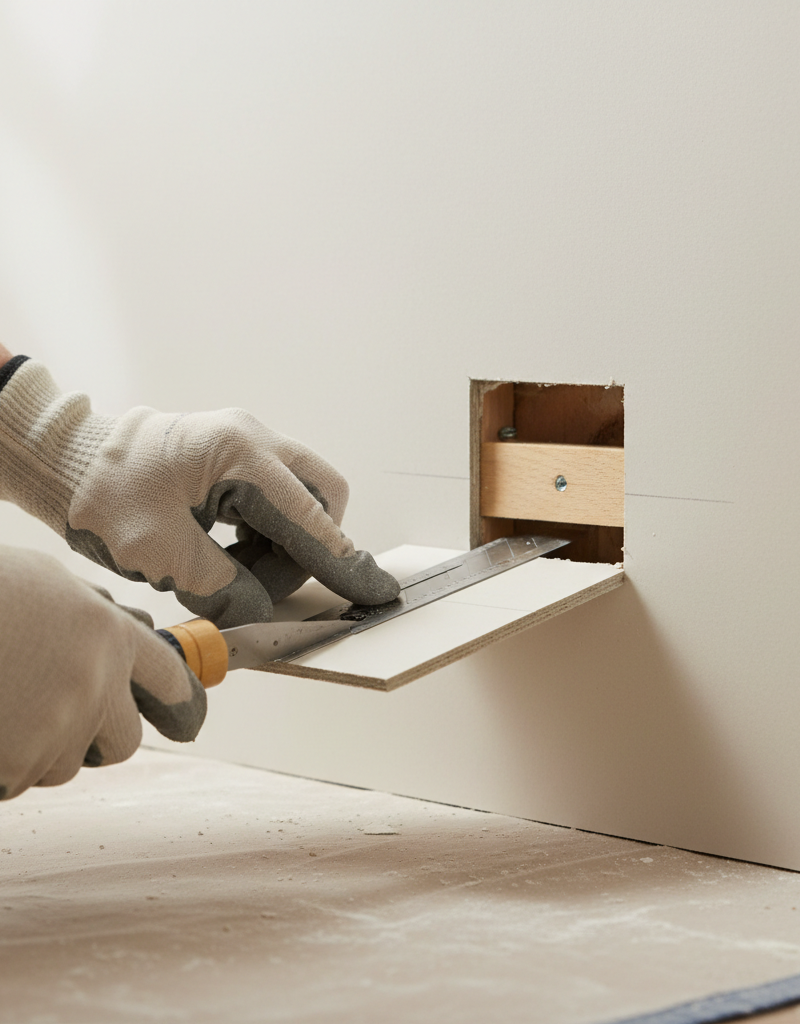
Step 1: Square and Prep the Hole — Using a utility knife and a small straightedge (like a speed square), carefully cut the damaged, irregular hole into a clean square or rectangle. Remove any loose drywall bits or torn paper from the edges. The goal is to have a neat, well-defined opening to work with.
-
Step 2: Cut the Patch Piece — Measure the dimensions of your squared-off hole. On a scrap piece of new drywall of the same thickness, measure and mark a square that is 2 to 3 inches larger in every dimension. For a 3x3 inch hole, you would cut a 5x5 or 6x6 inch square. Cut this piece out completely.
-
Step 3: Create the Paper Flange — Turn your new, larger patch piece over to the back (gray or brown paper) side. Center and draw the exact dimensions of the hole you are patching onto the back. Using your utility knife, carefully score along these lines, cutting through the back paper and about halfway into the gypsum core. Do not cut all the way through.
-
Step 4: Snap and Peel the Gypsum — Carefully snap the drywall along your score lines, breaking the gypsum core. Peel the broken outer sections of gypsum away from the front-facing white paper. You should be left with a central plug of gypsum perfectly sized for your hole, surrounded by a 1- to 1.5-inch border of paper. This is your California patch.
-
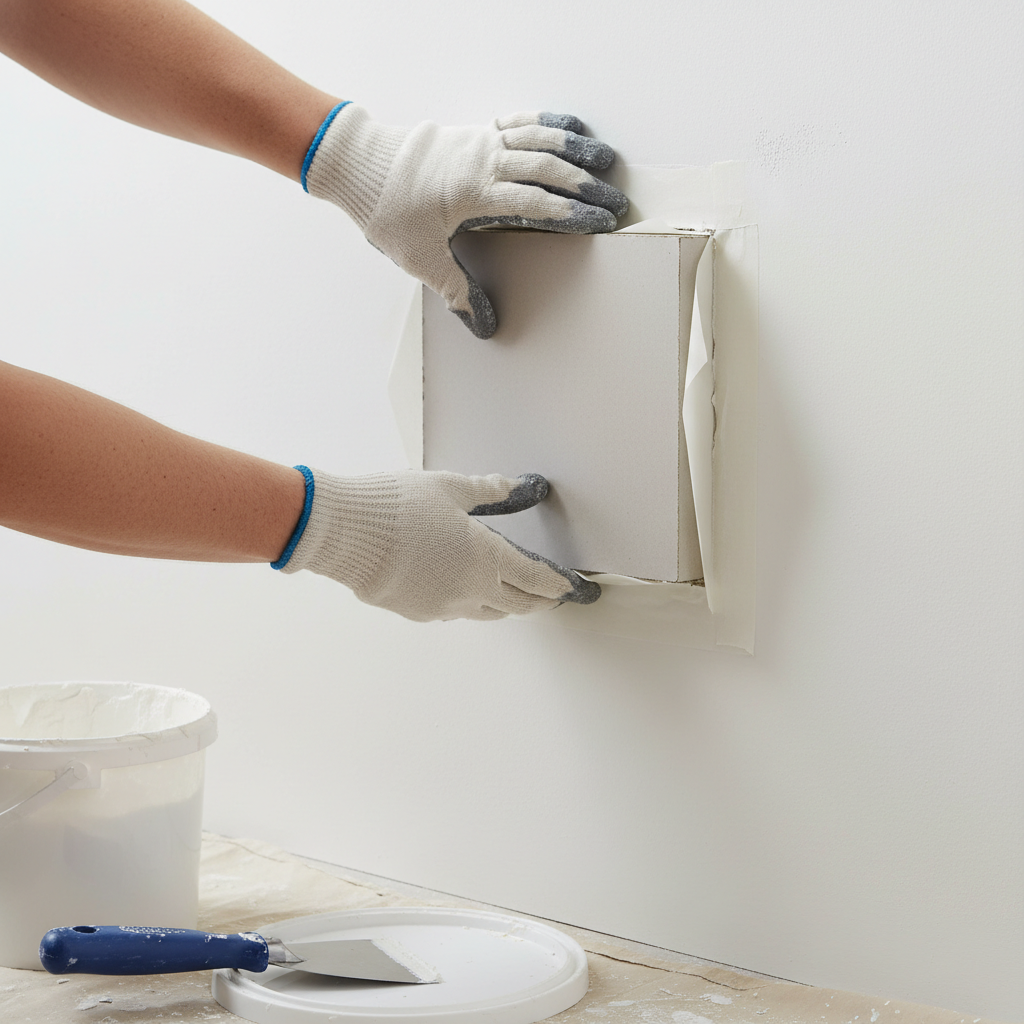
Step 5: Test Fit the Patch — Before applying any mud, check your work. The central gypsum plug should fit neatly into the hole in the wall, and the paper flange should sit perfectly flat against the surrounding wall surface. Trim the gypsum plug slightly if the fit is too tight; it should not be forced in.
-
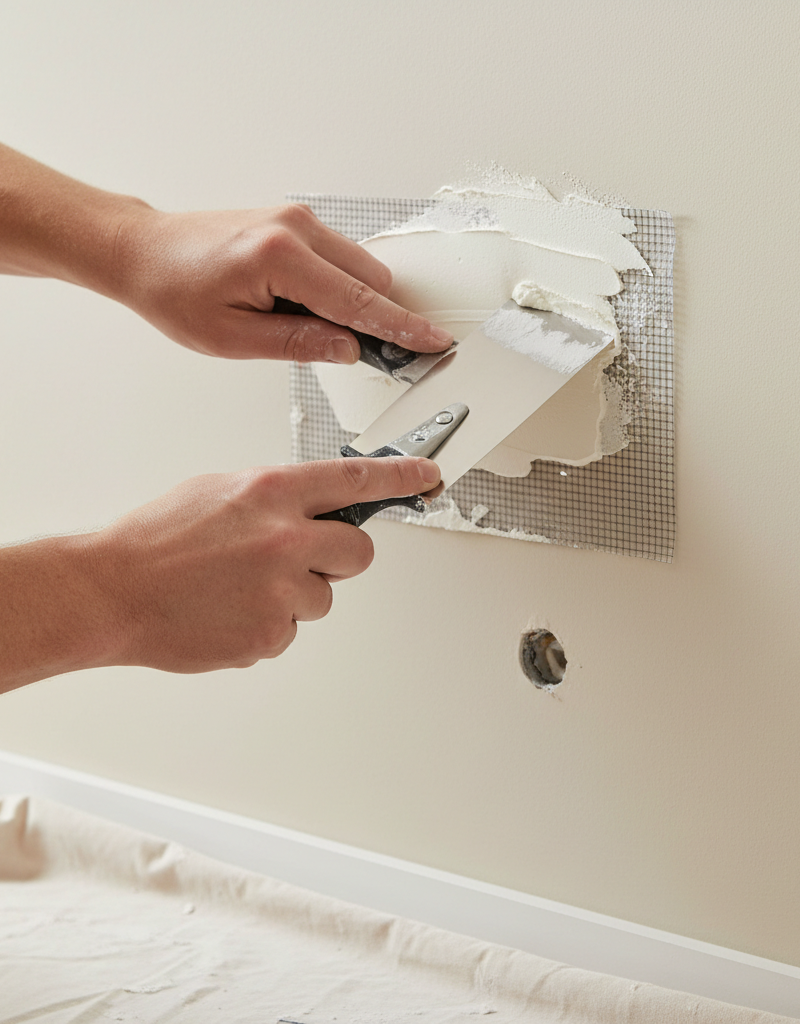
Step 6: Apply the First Coat of Mud — Using a 4- or 6-inch taping knife, apply a thin, smooth layer of all-purpose joint compound to the wall around the edges of the hole. This layer should be about the width of the paper flange. This "bedding" coat is what the paper will adhere to.
-
Step 7: Embed the Patch — Gently press the patch into place. The gypsum plug goes into the hole, and the paper flange presses into the wet compound. Starting from the center and working your way out, use your taping knife to press down on the paper, squeezing the excess mud out from underneath. The goal is to set the paper firmly with no air bubbles.
-
Step 8: Wipe and Feather the Edges — With the patch embedded, immediately apply a very thin coat of compound over the top of the paper flange, blending it into the wall. Use your taping knife at a low angle to feather the edges out smoothly. Let this coat dry completely, typically for 8-12 hours.
-
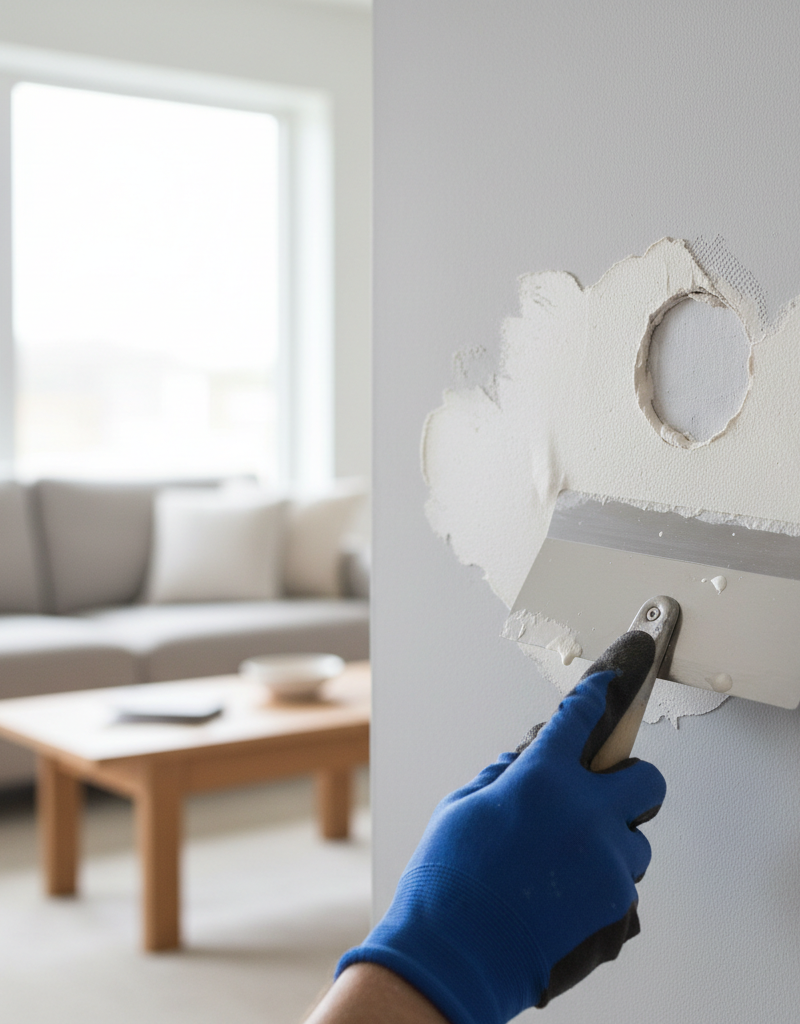
Step 9: Apply the Fill Coat — Once dry, use a wider (8- or 10-inch) taping knife to apply another thin coat of compound. This coat should extend several inches beyond the edge of your first coat. This wider feathering is critical for making the patch invisible. Let it dry completely.
-
Step 10: Apply the Final Skim Coat — For a perfect finish, apply one last, very thin skim coat with your wide knife, extending the feathered edge out even further. The goal is a wide, imperceptible ramp from the patch area to the original wall. Allow this to dry thoroughly, which may take up to 24 hours.
-
Step 11: Sand Smoothly — Using a fine-grit sanding sponge (220-grit), lightly sand the entire area. Use a gentle touch—you are only smoothing the compound, not trying to remove it. Feel the surface with your hand; it should feel perfectly flat with no ridges or bumps. Wipe away all sanding dust with a damp cloth.
-
Step 12: Prime and Paint — Before painting, you MUST apply a coat of PVA (polyvinyl acetate) drywall primer. This seals the porous joint compound and drywall paper, ensuring the final paint coat has a uniform sheen and won’t “flash.” Once the primer is dry, apply your matching wall paint.
Common Causes
- Doorknob Impacts: The most classic drywall hole. A door without a stopper is swung open with too much force, and the knob punches a perfect, and perfectly annoying, hole in the wall.
- Moving Furniture: Scuffs and gouges are common, but a sharp corner on a heavy dresser or bed frame can easily cause a significant puncture if it slips or is misjudged.
- Failed Anchors: Pulling a heavy picture, mirror, or shelf off the wall can sometimes cause the drywall anchor to fail, taking a chunk of the wall’s paper face and gypsum core with it.
- Accidental Impacts: A child’s toy, a dropped tool, or a clumsy moment can easily result in a small to medium-sized hole that needs a solid repair.
- Utility Access: Plumbers or electricians may need to cut a small, exploratory hole to diagnose a problem, locate a pipe, or fish a new wire. This leaves you with a clean but definite hole to patch.
Common Mistakes
- Using Adhesive Mesh Patches on Smooth Walls: While okay for textured walls where the pattern can hide imperfections, self-adhesive fiberglass mesh patches are almost always too thick for a smooth-surfaced wall. They create a noticeable hump that even multiple skim coats struggle to hide.
- Skipping the Primer: This is a fatal flaw in any drywall repair. Unprimed joint compound and drywall paper are far more porous than a painted wall. Paint applied directly over them will be absorbed differently, resulting in a dull, blotchy spot called "flashing" that is visible from across the room.
- Piling on Too Much Mud: The goal is not to fill the hole with a mountain of compound. The goal is to apply multiple thin coats, feathering each one progressively wider. Thick coats shrink, crack, and are difficult to sand smooth.
- Oversanding the Paper: Aggressive sanding, especially with a power sander or coarse-grit paper, can scuff and tear the paper on the patch and the surrounding wall. This creates a fuzzy texture that is impossible to hide with paint.
- Not Feathering Edges Wide Enough: A common rookie mistake is to contain the repair to a small area. A truly invisible drywall patch trick requires feathering the joint compound at least 6 to 10 inches away from the edge of the patch. The wider the feather, the more gradual the transition and the more invisible the result.
- Using the Wrong Joint Compound: Grabbing any tub of "spackle" is a mistake. For this drywall patch trick, you need all-purpose joint compound for taping and filling, and you could optionally use a topping compound for the final skim coat as it's lighter and easier to sand.
Cost & Time Breakdown
| Task | DIY Cost | Pro Cost | Time |
|---|---|---|---|
| Setup and Hole Preparation | $5 | $50 | 30 minutes |
| Patching & Mudding (3 coats) | $20 | $150 - $200 | 90 minutes (plus drying time) |
| Sanding & Cleanup | $5 | $40 | 30 minutes |
| Priming | $10 | $35 | 20 minutes (plus drying time) |
| Texture Matching (Aerosol) | $15 | $75 | 15 minutes |
| Final Painting (2 coats) | $20 | $100 | 45 minutes (plus drying time) |
| Total | ~$75 | ~$450 - $500 | ~4-5 Hours (spread over 2-3 days) |
Tips & Prevention
- Use a Setting-Type Compound for Speed: If you're in a hurry, you can use a setting-type compound ("hot mud") for the first one or two coats. It sets via a chemical reaction in 20-90 minutes (depending on the type you buy), drastically reducing waiting time. It is harder to sand, so always use all-purpose compound for your final skim coat.
- Invest in Decent Knives: Don't use a flimsy plastic putty knife. A set of flexible steel taping knives (6-inch and 10-inch) will give you much better control and a smoother finish. Keep them clean and rust-free.
- Install Door Stops: The best way to fix a doorknob hole is to prevent it. Install baseboard or hinge-pin door stops on all doors that could potentially hit a wall.
- Master the Damp Sponge: To minimize dust, you can do a final "wet sanding." After your last coat is dry, use a barely damp sponge to gently smooth out any minor ridges or lines. This melts the compound slightly and can produce a perfect finish with almost no airborne dust.
- Match That Texture: For orange peel or knockdown textures, you can buy aerosol texture cans at any home improvement store. Practice on a piece of cardboard first to get the spray pattern and distance right before applying it to the primed patch.
When to Call a Professional
While this drywall patch trick is incredibly effective for small to medium holes (up to about 6-8 inches), some situations are best left to a professional drywall contractor. If you are dealing with a hole larger than a dinner plate, a professional will use backer boards and a more robust taping process to ensure a stable, long-lasting repair.
Ceiling repairs are also significantly more difficult due to gravity; holding a patch overhead while applying compound is challenging and messy. Furthermore, if you see recurring or long, straight cracks, especially over doorways or windows, this could indicate a structural or foundation issue. A drywall pro can help diagnose if it's just a seam failure or a sign of deeper problems. Finally, if the damage was caused by a significant water leak, a professional should assess the extent of the water damage. They can ensure all moisture is gone and replace larger sections of affected drywall to prevent mold growth, a task that goes far beyond a simple patch.
Frequently asked questions
Can I use this drywall patch trick on plaster walls?+
No, this technique is specifically for gypsum board (drywall). Plaster walls are harder, less uniform, and require different patching materials and methods, often involving plaster of Paris or specialized plaster patching compounds.
What's the biggest hole this trick works for?+
This drywall patch trick is ideal for holes up to about 6 inches in diameter. For larger holes, the central gypsum plug becomes too heavy and may sag or fail. For holes larger than 6-8 inches, it's better to cut the section back to the nearest studs and install a larger, screw-supported patch.
Do I really need to use a special drywall primer?+
Yes, absolutely. Using a PVA (polyvinyl acetate) drywall primer is non-negotiable for an invisible repair. It seals the porous joint compound so that your topcoat of paint absorbs evenly, preventing a dull or blotchy spot known as 'flashing'. Regular wall paint primer is not formulated for this and may not seal the patch effectively.
My patch is still slightly visible. What did I do wrong?+
The most common reason is not feathering the compound wide enough. A 4-inch hole needs a patch area at least 12-16 inches wide to blend smoothly. Another reason could be skipping the primer, which causes the paint sheen to look different. Finally, make sure you used multiple thin coats, not one thick one.
Discussion
Loading comments…