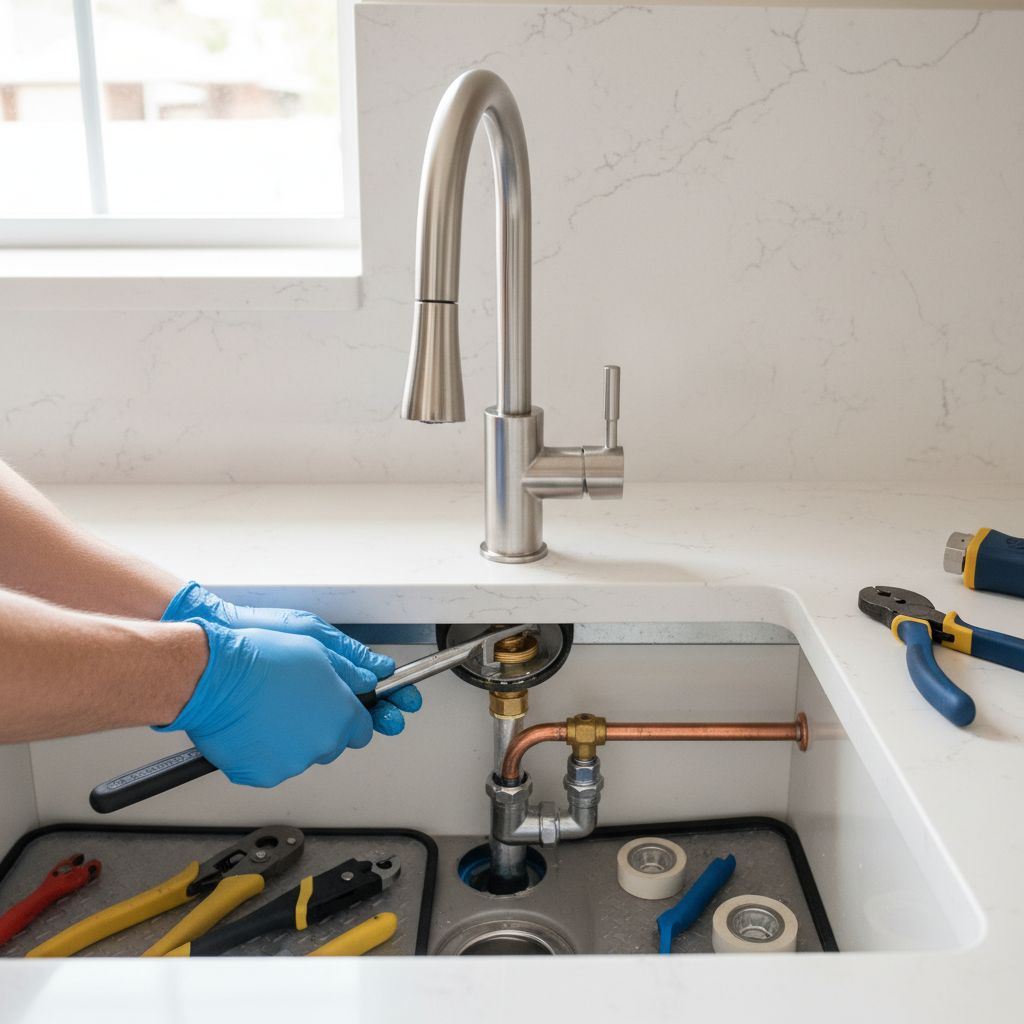
Tools & materials you'll need
Affiliate links- AmazonBasin Wrench1 · This is essential for reaching the mounting nuts.
- AmazonAdjustable Wrenches2 · A medium and large size will be useful.
- AmazonBucket1 · To catch water from the disconnected lines.
- AmazonHeadlamp or Flashlight1 · The under-sink area is always dark.
- AmazonSafety Glasses1 · To protect eyes from debris and drips.
- AmazonNew Faucet Kit1 · Ensure it's compatible with the number of holes in your sink.
- AmazonTowels2-3 · For cleaning up spills and protecting the cabinet.
- AmazonPenetrating Oil1 · Optional, but helpful for corroded nuts.
- AmazonPlumber's Putty or Silicone Sealant1 · Only if required by your faucet manufacturer.
- AmazonScrub Sponge and Cleaner1 · For cleaning the sink deck.
As an Amazon Associate FixlyGuide earns from qualifying purchases — at no extra cost to you. Prices and availability are accurate as of publication and subject to change.
Quick Answer
To replace a kitchen faucet, first turn off the hot and cold water shutoff valves under the sink and open the faucet to relieve pressure. Use a basin wrench to disconnect the water supply lines and remove the old faucet's mounting nuts. After cleaning the sink surface, install the new faucet and gasket, tighten it from below, connect the new water lines, and check carefully for leaks.
The Problem
A kitchen faucet isn’t just a source of water; it’s one of the most frequently used fixtures in any home. When it starts to fail, the problems go beyond simple inconvenience. The most obvious sign is a persistent drip, a constant plink-plonk that can waste hundreds of gallons of water per month, driving up your utility bills. You might also notice water pooling around the base every time you use it, a sign of a failed internal seal or gasket. This slow leak can seep into the countertop and the cabinet below, leading to warped particleboard, delaminated countertops, and even mold growth—a costly and unhealthy problem.
Over time, you may see visible signs of corrosion, like rust spots or green and white mineral buildup (scale) around the spout and handles. This not only looks unsightly but can also indicate the metal is breaking down from the inside. Functionally, the handle might become stiff and difficult to move, or the water pressure might drop significantly as internal passages get clogged with sediment. An old, dated faucet can also make an otherwise modern kitchen look tired. Replacing a kitchen faucet isn’t just about fixing a leak; it’s about preventing water damage, conserving water, restoring functionality, and giving your kitchen a surprisingly effective facelift.
How It Works
Understanding the components of your faucet system demystifies the replacement process. Your journey begins at the wall, where two pipes emerge: one for hot water, one for cold. Each pipe connects to a shutoff valve, typically a small oval or round handle. These valves are your control gates, allowing you to stop the water flow to the faucet without turning it off for the entire house.
From these valves, two flexible supply lines (often braided steel for durability) run upward to the faucet itself. They connect to the faucet's threaded inlet shanks, which are essentially two hollow bolts extending from the faucet body down through the holes in your sink or countertop. The entire faucet is held firmly in place from underneath by mounting nuts that are screwed onto these shanks. A rubber or plastic gasket or a bead of plumber's putty sits between the faucet base and the sink deck to create a watertight seal, preventing water on the counter from leaking into the cabinet below.
Inside the faucet body is the control center: one or two cartridges or valves. When you move the handle, the cartridge controls the mix of hot and cold water and regulates the flow rate. These cartridges contain rubber O-rings and ceramic discs that wear out over time, which is a primary cause of drips. For pull-down or pull-out models, a third flexible hose runs from the faucet body to the spray head, guided by a weight that helps it retract smoothly. Finally, the aerator, a small screen assembly screwed into the tip of the spout, infuses the water with air to create a soft, non-splashing stream and helps filter out sediment.
Step-by-Step Fix
1. Prepare Your Workspace — First things first, completely empty the cabinet under the kitchen sink. You'll need as much room to work as possible in this cramped space. Place a bucket and several old towels directly under the plumbing. This isn't just a suggestion—you will inevitably have some water spillage. A headlamp or flashlight is also essential, as it’s always darker under a sink than you expect.
2. Turn Off Water and Relieve Pressure — Locate the two water shutoff valves under the sink, one for the hot water pipe and one for the cold. Turn the handles clockwise until they are fully closed. Don't force them; if they are stuck, you may need to call a professional. Once closed, go back to the sink and turn the faucet handle(s) to the "on" position. A small stream of water will come out and then reduce to a trickle as the pressure is relieved; this is normal.
3. Disconnect Water Supply Lines — Now, position your bucket under the connections. Using an adjustable wrench or basin wrench, loosen the nuts connecting the supply lines to the shutoff valves. Lefty-loosey! Be prepared for a small amount of water to drain from the lines. Once disconnected from the valves, use your basin wrench to reach up and loosen the nuts connecting the supply lines to the faucet shanks themselves. This is often the trickiest part due to the awkward angle.
4. Unscrew the Old Faucet Mounting Nuts — This is the primary job for the basin wrench. This long-handled tool is designed specifically to reach up into the narrow space behind the sink basin. Latch the wrench’s jaw onto one of the large mounting nuts that hold the faucet to the sink deck. Turn the nut counter-clockwise. These can be stubborn, especially if they are old and corroded. A little penetrating oil can help, but patience is your best tool here. Remove all nuts holding the old faucet in place.
5. Remove the Old Faucet Assembly — With all the lines and nuts disconnected from below, you should now be able to pull the old faucet straight up and out from the top of the sink. If it has a separate pull-out sprayer, you'll need to disconnect its hose from the main faucet body underneath the sink before removing it. Be careful, as the old assembly can be grimy and may still have some water in it.
6. Clean the Sink Deck Thoroughly — The area under your old faucet is likely caked with soap scum, mineral deposits, and old plumber’s putty. Use a plastic putty knife or a razor blade (held at a low angle to avoid scratching) to scrape away all the old gunk. A good-quality mineral deposit remover and a non-abrasive scrub sponge will help you get the surface perfectly clean and smooth. This step is critical for ensuring the new faucet’s gasket creates a perfect, watertight seal.
7. Mount the New Faucet and Gasket — Unpack your new faucet and identify the base gasket or deck plate. Some faucets are designed to be sealed with a pre-formed rubber or plastic gasket, while others may require a bead of plumber's putty. Follow the manufacturer's instructions precisely. Feed the new faucet’s supply lines and mounting shanks down through the hole(s) in the sink deck, ensuring it’s aligned correctly.
8. Secure the Faucet from Underneath — From under the sink, slide the new mounting washers and nuts onto the faucet’s threaded shanks. Hand-tighten them as much as you can first to ensure the faucet is sitting straight from above. Then, use your basin wrench to snug them up, turning clockwise. The key here is to get them tight enough to prevent the faucet from wobbling, but do not over-tighten, as this can crack the sink deck or damage the faucet’s gasket.
9. Connect the New Supply Lines — Your new faucet likely has integrated supply lines. Connect the hot line (usually marked red or with a tag) to the hot water shutoff valve and the cold line to the cold valve. The connections should be hand-tightened first, followed by a gentle quarter- to half-turn with an adjustable wrench. Over-tightening can damage the rubber seals inside the connectors and cause leaks.
10. Attach Sprayer Hose and Weight — If you have a pull-down or pull-out model, find the dedicated hose for the sprayer head. Click or screw it onto its connection point on the main faucet body, as shown in the instructions. Then, clamp the included weight onto the sprayer hose at the designated spot (the instructions will specify the location). This counterweight is what allows the sprayer to retract back into the spout smoothly.
11. Flush and Test for Leaks — Before you turn the water on, make sure the faucet handle is in the "off" position. Remove the aerator from the tip of the new faucet. Slowly turn on both shutoff valves, turning them counter-clockwise. Let the water run for a minute to flush out any debris from the installation process, then turn the faucet off. Now, with a dry paper towel, wipe every single connection point you touched: at the shutoff valves, at the faucet body, and where the sprayer hose connects. Check for even the smallest hint of moisture. Turn the faucet on and check again.
12. Final Cleanup and Inspection — Once you are 100% confident there are no leaks, reinstall the aerator. Test the faucet’s full range of motion, including the hot/cold mix and the sprayer function. If everything works and all connections are dry, you can load all your supplies back into the cabinet. Keep the towels and bucket handy for a day or two and double-check for slow drips just to be safe.
Common Causes
Why do you have to replace a kitchen faucet in the first place? Faucets fail for a few predictable reasons:
- Worn Seals and O-Rings: Inside the faucet body, small rubber O-rings and seals are constantly under pressure and in motion. Over years of use, they wear down, dry out, and crack, becoming the number one cause of drips from the spout or leaks around the handle.
- Cartridge Failure: Modern faucets use a cartridge system. This self-contained valve can wear out from use or become damaged by sediment in the water, leading to drips or a stiff, hard-to-move handle.
- Mineral Buildup (Scale): If you have hard water, calcium and magnesium deposits can build up inside the faucet’s small internal passages and on the valve seats. This scaling can restrict water flow, cause drips that are impossible to stop, and eventually seize the handle.
- Corrosion: Water is the universal solvent. Over a decade or more, water can corrode the metallic parts of the faucet from the inside out. You might see this as rust on the exterior, but the real damage is often unseen within the valve body itself, leading to microscopic cracks and persistent leaks.
Common Mistakes
- Not Fully Turning Off Shutoff Valves: Homeowners are often timid with old valves. If you don't turn the handle fully clockwise until it stops, it can still pass water, leading to a major spray when you disconnect the supply lines.
- Over-Tightening Connections: This is the most common DIY mistake. The instinct is to crank down on every nut to prevent leaks, but this crushes the rubber seals inside supply lines and can crack the mounting hardware or even the sink itself. The rule is hand-tight, then a quarter-turn with a wrench.
- Using the Wrong Tools: Trying to do this job with a regular adjustable wrench or channel-lock pliers is a recipe for frustration and busted knuckles. A basin wrench is the only tool that can properly reach and turn the mounting nuts in the tight space behind a sink.
- Forgetting to Clean the Sink Deck: Any grit, grime, or old putty left on the sink surface will compromise the new gasket's seal. This creates a pathway for water to leak into your cabinet, defeating the purpose of the replacement.
- Not Flushing the New Faucet: Skipping the step of removing the aerator and flushing the lines can clog your brand-new faucet immediately. Sediment and debris shaken loose during the installation get trapped in the aerator, ruining the water pressure from the very first use.
- Throwing Away the Instructions: Every faucet is slightly different. The instructions contain critical information about whether to use putty, where to place the sprayer weight, and the specific order of washers and nuts. Always read them before you start.
Cost & Time Breakdown
Replacing a kitchen faucet is a high-impact DIY project with significant cost savings.
| Task | DIY Cost | Pro Cost | Time |
|---|---|---|---|
| New Faucet (Mid-Range) | $150 - $350 | $150 - $350 | 1 hr (Shopping) |
| Basin Wrench | $15 - $25 | Included | - |
| Adjustable Wrenches | $20 - $40 | Included | - |
| Bucket, Towels, Safety Glasses | $10 - $20 | Included | - |
| Labor | $0 | $200 - $450 | 2 - 4 hours |
| Total | $195 - $435 | $350 - $800 | 2 - 4 hours |
Tips & Prevention
- Clean Your Aerator Regularly: At least twice a year, unscrew the aerator from the faucet spout and soak it overnight in a cup of white vinegar. This dissolves mineral buildup and keeps your water flow strong and steady.
- Choose Quality: While a $50 faucet seems tempting, they often use plastic internal components that wear out quickly. Investing in a reputable brand name known for brass construction and ceramic disc cartridges will pay off in longevity.
- Address Drips Immediately: A small drip is a warning sign. The sooner you replace the cartridge or seals, the less wear and tear you put on the faucet body and valve seat, potentially extending its life by years.
- Know Your Shutoff Valves: Once a year, gently turn your sink’s shutoff valves all the way off and back on again. This prevents them from seizing up from mineral deposits, so they’ll work when you really need them to.
- Keep the Installation Manual: File away the installation manual and any special tools that came with your faucet. When it eventually starts to drip, this manual will tell you the exact part number for the replacement cartridge.
- Wipe Down the Base: After doing dishes, wipe away any standing water from the base of the faucet. This prevents hard water stains and stops moisture from breaking down the sealant over time.
When to Call a Professional
While this is a very manageable DIY project, there are definite times to put down the wrench and call a licensed plumber. If your shutoff valves are corroded and won't budge, or if they spin freely without stopping the water, do not force them. A broken shutoff valve can cause a catastrophic flood. A professional can replace these valves safely, often by shutting off water to the whole house.
Similarly, if you discover the floor of your sink cabinet is soft, spongy, or shows signs of extensive water damage and mold, it’s wise to get a pro’s opinion. They can assess the extent of the damage and determine if simple faucet replacement is enough. Finally, if your water supply pipes coming out of the wall are old, corroded, or you suspect they are galvanized steel, it's best to let a plumber handle the job. The risk of cracking an old pipe is too high. A pro can complete the job quickly, guarantee their work against leaks, and handle any unexpected issues that arise with old plumbing, providing peace of mind that a DIY project sometimes can't.
Frequently asked questions
Do I need plumber's putty to replace a kitchen faucet?+
It depends on the new faucet. Many modern faucets come with a pre-installed rubber or silicone gasket that creates the seal, and in these cases, you should NOT use plumber's putty. However, if your faucet has a flat metal base and does not include a gasket, you will need to apply a rope of plumber's putty around the base to ensure a watertight seal. Always follow the manufacturer's installation instructions.
How long does a kitchen faucet last?+
A good quality kitchen faucet from a reputable brand can last 15-20 years. Less expensive models with more plastic components may only last 5-10 years. The lifespan is also affected by the hardness of your water and how quickly you address small drips and leaks.
What is the hardest part of replacing a kitchen faucet?+
For most people, the hardest part is removing the old faucet. The mounting nuts are often "frozen" in place by years of corrosion and are located in a very tight, awkward space behind the sink basin. This is where having the right tool, a basin wrench, makes all the difference.
Can I replace a 3-hole faucet with a 1-hole faucet?+
Yes, you absolutely can. Most single-hole faucets come with an optional deck plate (escutcheon) designed to cover the unused a 3-hole, 4-inch-center sink. Make sure the faucet you buy either includes this plate or that you purchase one that matches the faucet's finish.

Discussion
Loading comments…