Tools & materials you'll need
Affiliate links- AmazonSmall flat-head screwdriverFor adjusting rotor heads or some adjustable spray nozzles
- AmazonPliersOptional, for rotating stubborn fixed spray risers, use with caution
- AmazonStiff brush or old toothbrushFor cleaning clogged nozzles
- AmazonPaperclip or thin wireTo clear small nozzle clogs, use with care
As an Amazon Associate FixlyGuide earns from qualifying purchases — at no extra cost to you. Prices and availability are accurate as of publication and subject to change.
Quick Answer
Misdirected sprinkler spray, whether it's hitting your house, driveway, or sidewalk, is usually a straightforward fix for homeowners. Most often, the issue stems from an improperly aimed nozzle, an incorrect arc setting, or a clogged spray head. You can typically resolve these problems in minutes with simple adjustments to the sprinkler head and nozzle, often requiring no tools or just a small flat-head screwdriver.
The Problem
Picture this: you’ve invested time and money in a lush, green lawn, and a properly installed sprinkler system to keep it that way. Yet, every time your sprinklers run, you notice water pooling on your driveway, drenching your siding, or creating puddles on your patio. This isn't just wasteful; it can cause real damage. Excess water on hard surfaces can lead to dangerous slippery conditions, accelerate concrete degradation, and contribute to mildew and water damage on your home's exterior. Over-watering specific areas of your lawn can also lead to fungal diseases, while under-watering others can leave them dry and brown. The core problem is an inefficient and damaging spray pattern.
How It Works
Understanding how your sprinkler heads work is crucial for effective adjustment. There are two main types of sprinkler heads you'll encounter in most residential systems: spray heads and rotor heads.
Spray Heads: These are typically fixed-position heads that pop up from the ground and emit a constant, fan-shaped spray pattern. They cover a specific area, often 4 to 15 feet, and are common in smaller, more irregularly shaped lawn sections. The spray pattern is defined by the nozzle installed, which can be full circle, half circle, quarter circle, or various custom shapes. Most spray nozzles have a 'fixed arc' but their direction can be rotated. Some advanced spray nozzles, often called 'rotary nozzles' or 'MP rotators', actually have multiple streams that slowly rotate, offering better water distribution and a slightly longer throw than traditional spray heads, but they are still characterized by their fixed-area coverage without significant moving parts in the head itself.
Rotor Heads: These sprinkler heads rotate a single or multiple streams of water back and forth over a set arc. They're designed for larger areas, typically covering distances from 15 to 50 feet or more. Rotor heads usually have two primary adjustments: the arc (the range of motion the head covers, e.g., 90 degrees, 180 degrees, or 360 degrees) and the throw distance (how far the water sprays). The internal mechanism often involves a gear-driven system propelled by water pressure, causing the nozzle to sweep across the designated area. Adjusting a rotor head often involves defining the left and right stop points of its rotation, as well as the radius of its spray.
Both types of heads rely on adequate water pressure from your system to function correctly. If pressure is too low, the spray will be weak and won't reach its intended distance; if it's too high, the water can atomize, becoming a fine mist that's easily carried away by wind, or create excessive runoff.
Step-by-Step Fix
Fixing a misdirected sprinkler spray is generally a quick and straightforward process once you identify the type of sprinkler head you have.
1. Identify Your Sprinkler Head Type — Determine if it's a fixed spray or rotor head.
- Fixed Spray Head: Pops up and sprays a constant fan of water. Nozzle doesn't rotate on its own. Often has different colored nozzles for various patterns. These are the most common in smaller lawn areas.
- Rotor Head: Pops up and rotates a single or multiple streams of water back and forth. These often cover larger distances.
2. Prepare for Adjustment — Ensure safety and clear the area.
- Safety First: Turn off your irrigation system at the controller before making any adjustments to avoid getting sprayed or damaging the heads. Wear old clothes or rain gear if the system might come on unexpectedly.
- Clear Debris: Gently remove any grass, dirt, or debris around the sprinkler head that might obstruct the spray pattern or prevent it from popping up fully.
3. Adjust Fixed Spray Heads — Orient the spray pattern correctly.
- Power On Safely: Briefly turn on the zone where the affected sprinkler is located. Observe the spray pattern to confirm the problem.
- Turn Off Power: Turn the zone off again.
- Orient the Nozzle: Most fixed spray heads allow you to grasp the base of the pop-up riser (the part that comes out of the ground) and gently rotate it by hand to change the direction of the spray. Hold the body of the sprinkler head (the part buried in the ground) steady with one hand and rotate the riser with the other. The spray pattern should align with your desired coverage area. Some older or very tight heads may require a gentle twist with a pair of pliers on the riser, but be careful not to damage the plastic.
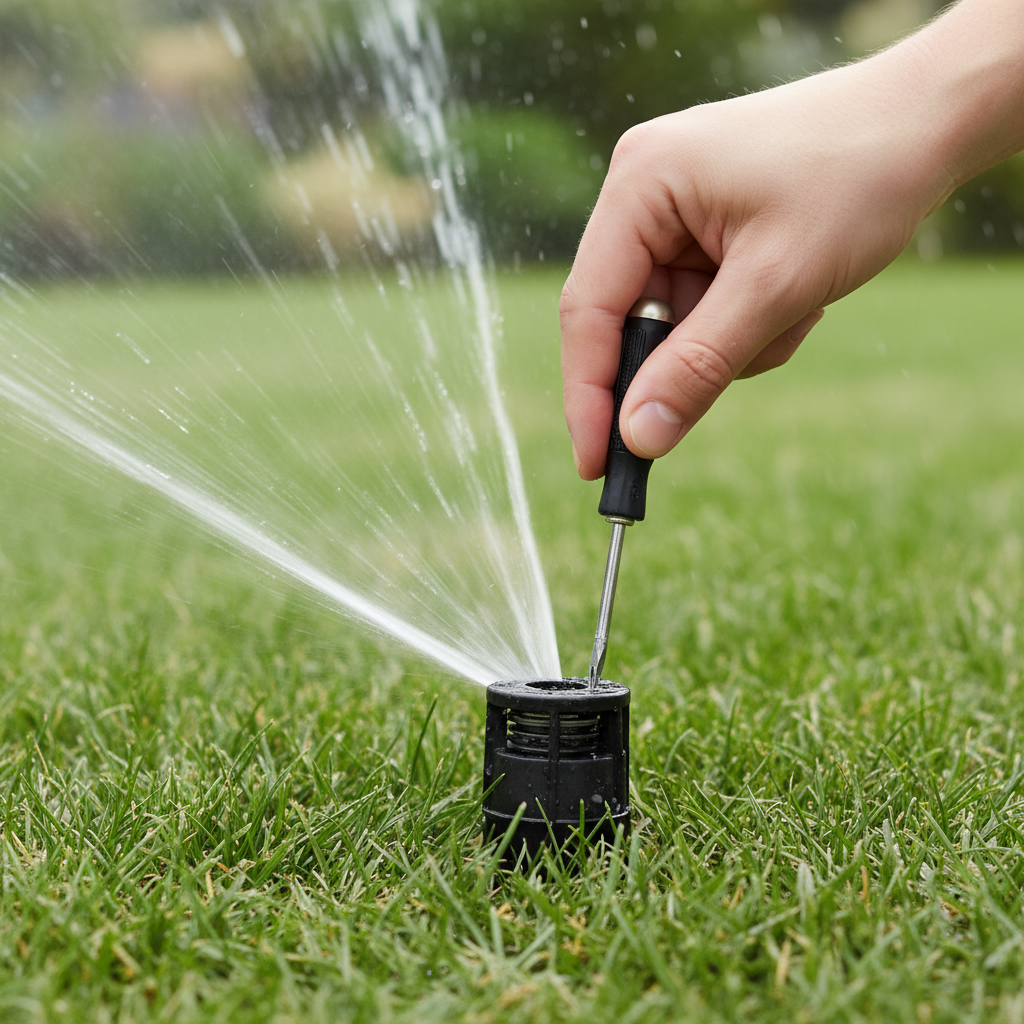
- If it's a specialty nozzle (e.g., adjustable arc spray nozzle): Check the top of the nozzle for small arrows or indicators. These often have a collar that twists to widen or narrow the arc. Follow the manufacturer's instructions, but generally, twisting the top half of the nozzle adjusts the arc. A small flat-head screwdriver might be needed for the radius screw.
4. Adjust Rotor Heads (Arc and Distance) — Set the rotation and throw distance.
- Identify the Set Points: Most rotor heads have indicators for the left and right stop points of their rotation. You'll typically set the right stop point first (this is often fixed or can be rotated by hand to the desired right edge) and then adjust the arc from there.
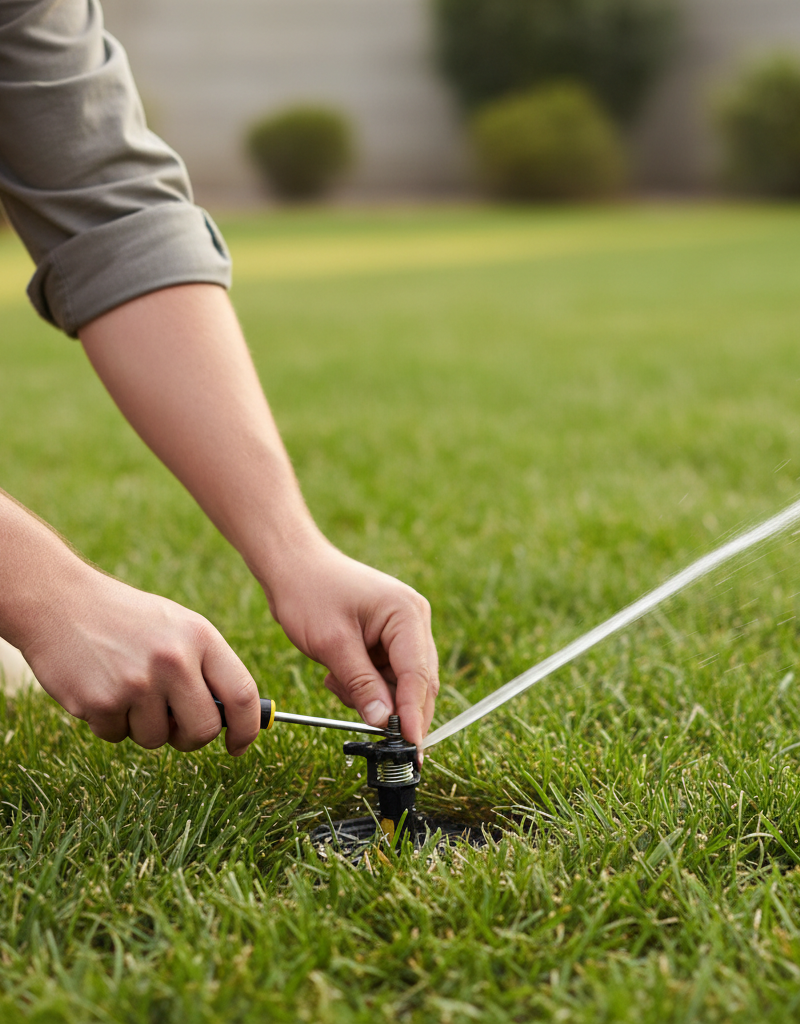
- Adjusting the Arc: Rotor heads usually have a slot on the top (often marked with a plus/minus or an arc symbol) for a flat-head screwdriver. With the system running briefly, turn the screw clockwise to decrease the arc (make it spray a smaller angle) or counter-clockwise to increase the arc (make it spray a wider angle). Some models allow you to pull up the sprinkler riser and physically rotate the nozzle turret to set the starting left point, then use the screw to adjust the right point relative to that.
- Adjusting the Throw Distance: Look for a small screw, often positioned directly in the path of the water stream on the nozzle. Turning this screw clockwise will push a small pin into the stream, breaking it up and reducing the throw distance. Turning it counter-clockwise will retract the pin, increasing the distance. Do this in small increments and observe the effect.
- Run System and Observe: Briefly turn on the zone to check your adjustments. Fine-tune as needed. It may take a couple of cycles to get it perfect.
5. Check for Clogs and Damage — Inspect for blockages that disrupt spray.
- Clogged Nozzle: If the spray pattern is distorted, weak, or completely absent from part of the head, the nozzle might be clogged. With the system off, pull up the riser (or unscrew the top of the rotor head cartridge) and carefully remove the nozzle. Rinse it under clean water to remove dirt, grit, or mineral deposits. A soft brush or a straightened paperclip can help dislodge stubborn debris. Never use a pick or needle that could scratch the plastic.
- Damaged Head/Nozzle: If the nozzle or the sprinkler head body is cracked, broken, or severely worn, it may need replacement. Sometimes, just the nozzle itself can be replaced, which is a much cheaper and easier fix than replacing the entire sprinkler body.
- Low Water Pressure: If multiple heads in a zone are spraying weakly, the issue might be low water pressure, not individual head adjustment. This could be due to a partially closed main valve, a leak in the line, or too many heads on a single zone. If you suspect low pressure, contact an irrigation professional.
Common Causes
- Improper Nozzle Aim: The most frequent culprit. Over time, physical impacts (lawnmowers, children playing, pets) or even ground settling can knock a nozzle out of alignment.
- Incorrect Arc Settings (Rotor Heads): The rotational sweep of a rotor head might be set too wide, covering areas beyond the intended lawn boundary, or too narrow, leaving dry spots.
- Throw Distance Miscalculation: The water stream might be reaching too far or falling too short, often due to an initial setup error or changes in water pressure.
- Clogged Nozzles: Dirt, sediment, mineral deposits, grass clippings, or even small insects can partially or fully block a nozzle, distorting the spray or reducing its output.
- Damaged Sprinkler Heads: Cracked or broken nozzles, risers, or internal components can lead to uncontrolled spraying or leaks.
- Water Pressure Fluctuations: While less common for
Frequently asked questions
Why is my sprinkler spraying the road?+
Your sprinkler is likely spraying the road due to an incorrect nozzle aim or an arc setting that's too wide. For fixed spray heads, rotate the riser to redirect the spray. For rotor heads, adjust the left and right stop points of its rotation and possibly the arc using a flat-head screwdriver to reduce its coverage.
Can I adjust a sprinkler without turning off the water?+
It is not recommended to adjust a sprinkler while the water is on. While some minor adjustments to rotor head arc screws can be made with water running, it's safer and more effective to turn off the water to avoid getting soaked, ensure accurate adjustments, and prevent potential damage to the sprinkler head.
How do I make my sprinkler spray shorter?+
To make your sprinkler spray shorter, you'll need to adjust the throw distance. On most rotor heads, there's a small screw on top of the nozzle. Turning this screw clockwise will insert a pin into the water stream, breaking it up and reducing the throw distance. For fixed spray heads, you might need a different nozzle with a shorter range.
How do I know what kind of sprinkler head I have?+
You can identify your sprinkler head type by observing its operation. Fixed spray heads pop up and emit a constant, fan-shaped spray without rotating. Rotor heads pop up and rotate back and forth, emitting a single or multiple streams of water over a larger distance. Pop onto your lawn while they are running or manually pull them up to observe.
My sprinkler head isn't popping up fully. What's wrong?+
If your sprinkler head isn't popping up fully, it's likely due to debris obstructing the riser, low water pressure, or a damaged spring. First, clear any dirt or grass around the head. If that doesn't work, check for clogs in the nozzle (clean out any debris) or assess your system's overall water pressure. In some cases, the internal spring may be broken, requiring a replacement head.
Why is only one spot of my lawn getting wet?+
If only one spot of your lawn is getting wet, it could be a sign of a severely misaimed nozzle on a fixed spray head, a rotor head with its arc set to an extremely narrow angle, low water pressure preventing full coverage, or a partially clogged nozzle that's only letting a stream of water through one opening. Ensure nozzles are clear and heads are properly aimed and adjusted.
Discussion
Loading comments…