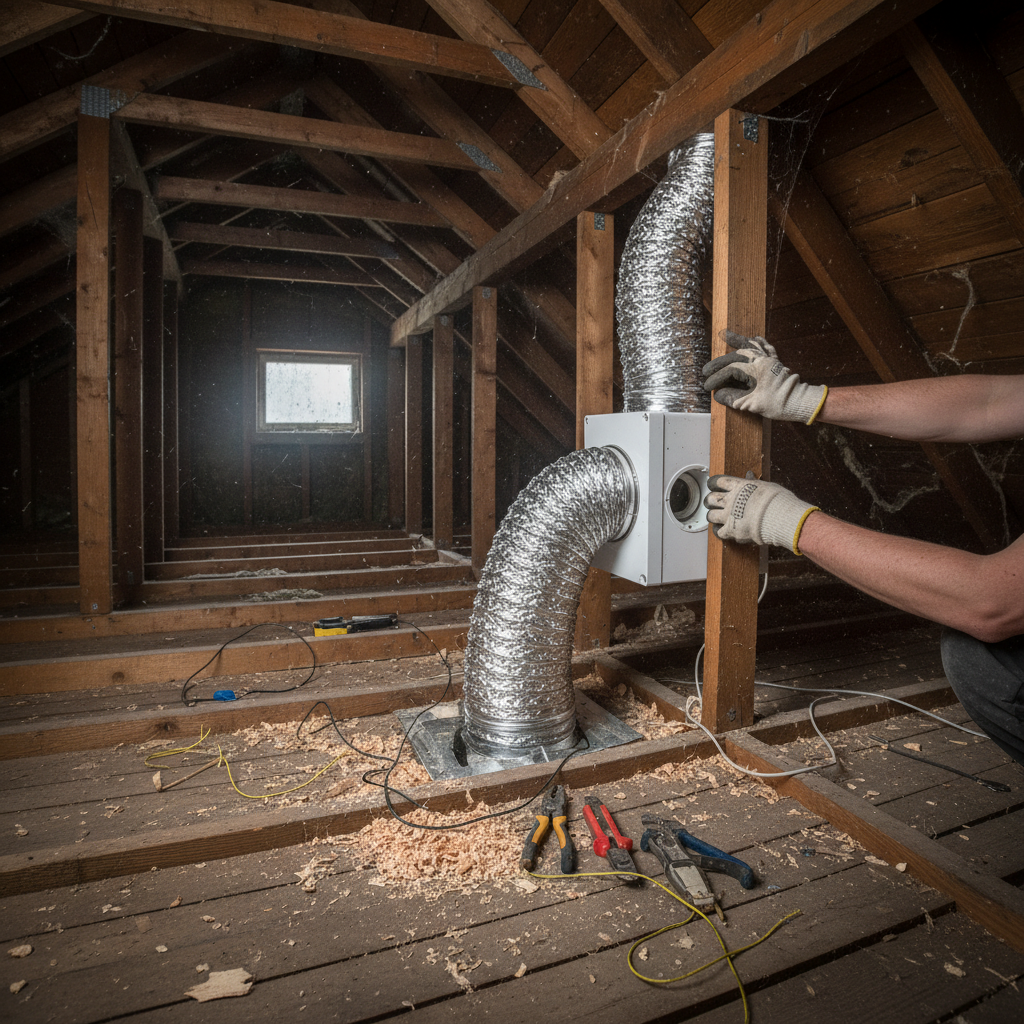
Tools & materials you'll need
Affiliate links- AmazonInsulated Flexible Duct (R-6 or R-8)1 · 4-inch or 6-inch diameter to match fan outlet.
- AmazonRoof Vent Cap (or Wall Vent Cap)1 · Ensure it has a backdraft damper and pest screen.
- AmazonRoofing Sealant1 tube · High-quality, weatherproof sealant for exterior use.
- AmazonAluminum Foil Tape1 roll · Do not use standard duct tape.
- AmazonWorm-Drive Clamps2 · Metal clamps sized for your duct diameter.
As an Amazon Associate FixlyGuide earns from qualifying purchases — at no extra cost to you. Prices and availability are accurate as of publication and subject to change.
Quick Answer
A bathroom exhaust fan vented into the attic deposits warm, moist air that causes condensation, mold, and wood rot on your insulation and roof structure. The proper fix is to install insulated ducting from the fan to a dedicated vent cap that exhausts theair completely outside, typically through the roof or a gable wall.
The Problem
You run your bathroom exhaust fan after every shower, just like you're supposed to. You hear it whirring away, clearing the steam from the mirrors, and you assume it's doing its job. But in thousands of homes, that fan is hiding a destructive secret: it isn't venting outside at all. Instead, it's dumping gallons of moisture-laden air directly into your attic.
This single, common mistake—often the result of a builder shortcut or a botched DIY installation—is a silent menace quietly destroying your home from the inside out. Over weeks and months, the consequences begin to appear, though you may not connect them to the fan. You might notice persistent, musty odors in the bathroom or adjacent rooms that no amount of cleaning can remove. You may see subtle, yellowish-brown water stains appearing on the ceiling around the fan housing. The paint on your bathroom ceiling might start to peel, bubble, or flake for no apparent reason.
In the attic, the situation is far more dire. During winter, you might see frost clinging to the underside of the roof sheathing or on the nails sticking through the wood. As this frost melts, it drips down, saturating your insulation and rendering it ineffective. This sustained moisture creates the perfect breeding ground for black mold and mildew, which can colonize huge swaths of your roof decking, trusses, and joists. This isn't just an aesthetic issue; mold feasts on organic materials like wood and the paper backing of drywall, leading to structural rot that can compromise the integrity of your roof. A single 20-minute shower can release over half a gallon of water vapor into the air. Venting that into a confined, unconditioned attic space is like setting up a terrarium for mold and rot. Fixing this improper bathroom fan venting is not just about home maintenance; it's about protecting your home's value and your family's health.
How It Works
To understand why venting a bathroom fan into the attic is so damaging, you have to understand the basic physics of air, temperature, and moisture. Your home's interior is a conditioned environment—relatively warm and stable. Your attic, by design, is an unconditioned space, meaning it closely mirrors the outside temperature, being cold in the winter and hot in the summer.
The exhaust fan's sole purpose is to remove warm, humid air generated by showers and baths. This air is not just steamy; it holds a significant amount of water in a gaseous state (water vapor). When the fan pumps this warm, moist air into a cold attic, the air cools down rapidly. Colder air cannot hold as much moisture as warmer air. As the air cools past its "dew point," the excess water vapor is forced to change state from a gas back into a liquid. This process is called condensation.
It’s the same phenomenon you see when a cold glass of lemonade "sweats" on a hot summer day. The surface of the glass is colder than the surrounding air's dew point, causing water vapor from the air to condense on it. In your attic, the cold surfaces are the roof sheathing, roofing nails, and wood trusses. The moisture-laden air hits these surfaces and releases liquid water, coating everything in a fine layer of dampness. This persistent dampness, combined with organic food sources (wood, paper, dust), creates the ideal ecosystem for mold and mildew to flourish and for wood-destroying fungi to cause rot. Proper bathroom fan venting works by creating a sealed, insulated pathway to move this moisture all the way outside before it has a chance to cool down and condense where it can do harm.
Step-by-Step Fix
This guide assumes you have an existing fan that is either not vented or is vented improperly into the attic space. The goal is to install a new, insulated duct from the fan housing to a new vent cap on the roof.
-
Safety First & Power Off — Before any work begins, locate the circuit breaker that controls your bathroom fan and turn it off completely. Verify the power is off by trying to turn the fan on at the switch. If you are not 100% confident in electrical work, do not proceed.
-
Gear Up and Inspect — Get your personal protective equipment (PPE). In a dusty, potentially moldy attic, this means an N95 respirator mask, safety glasses, and gloves. Head into the attic and locate the bathroom fan housing. Examine the outlet port. Is there a duct attached? If so, where does it go? Does it terminate in the middle of the attic? Is it disconnected? Note the situation and the diameter of the fan's outlet (typically 4 inches).
-
Plan the Duct Route — Determine the best path for the new duct. The ideal route is the shortest and straightest path from the fan to the outside. For most homes, this will be straight up through the roof. Choose an exit point on the roof that is between two rafters and at least a few feet away from any existing vents or chimneys.
-
Mark the Roof Exit Point — From inside the attic, carefully drive a long (3-inch or longer) nail or screw straight up through the roof sheathing at the exact center of your chosen exit point. This marker will allow you to find the precise location from on top of the roof.
-
Cut the Roof Hole — Securely position your ladder and get on the roof. Locate your marker nail. Use the metal pipe of your new roof vent cap to trace a circle onto the shingles around the nail. Use a utility knife to cut away the shingles inside this circle. Then, using a drill with a spade bit to create a starting hole and a jigsaw or reciprocating saw, carefully cut out the circular hole through the roof decking.
-
Install the Roof Vent — Gently pry up the shingles on the "uphill" side of the hole. Apply a thick, continuous bead of roofing sealant to the entire underside of the roof vent's metal flange. Slide the top of the flange underneath the pried-up shingles and center the vent pipe in the hole. The bottom of the flange should lie on top of the downhill shingles. Secure the flange to the roof decking using roofing nails in the provided holes. Finally, apply more sealant over every nail head to ensure a watertight seal.
-
Attach Duct to the Fan — Back in the attic, take your insulated flexible duct. Pull back the outer insulation layer to expose the inner flexible pipe. Slide this pipe over the fan housing's outlet port. Secure it tightly using a 4-inch metal worm-drive clamp. For an airtight seal, wrap the connection point thoroughly with aluminum foil tape.
-
Run and Connect the Duct — Stretch the insulated duct from the fan to the pipe of the newly installed roof vent. Keep the run as straight as possible, avoiding sharp bends or kinks that restrict airflow. If the run is long, use duct straps to support it from the rafters. Pull the outer insulation and inner pipe over the roof vent pipe extending down into the attic.
-
Seal the Final Connection — Just as with the fan connection, secure the duct to the roof vent pipe with a worm-drive clamp. Cinch it down tightly. Wrap this connection point completely with aluminum foil tape to prevent any attic air from leaking in or bathroom air from leaking out.
-
Insulate the Fan Housing — The metal or plastic housing of the fan itself can get cold in the attic, causing condensation. Loosely cover the entire fan housing with blown-in or batt insulation to keep it closer to the temperature of the room below. Do not pack it tightly.
-
Restore Power and Test — Head back to the breaker box and turn the circuit back on. Go into the bathroom and turn on the fan. You should hear it running. Safely check from the ground outside to see if you can feel or see air being exhausted from the new roof vent cap. If possible, do a final quick check in the attic to feel for any air leaks at your taped connections.
Common Causes
Understanding why this problem occurs can help you spot it in other homes or prevent it in future projects.
- Builder Negligence: In tract housing developments, speed and cost-cutting are paramount. Foremen may "forget" to have the roofer or HVAC tech complete the final vent connection, saving a hundred dollars and a couple of hours per house. The fan gets installed and turns on, so it passes a cursory inspection.
- DIY Misinformation: A homeowner or handyman replacing an old fan might not understand the critical importance of exterior venting. They may think venting into a "drafty" attic is sufficient, not realizing the sheer volume of moisture they are introducing.
- Outdated Building Codes: In some very old homes (pre-1980s), codes may not have been as strict about mechanical ventilation, though this is rare. More often, the original fan was never vented properly in the first place.
- Disconnected Ducts: Previous work in the attic (like electricians running new wires or cable installers) can lead to ducts being accidentally crushed, disconnected, or pulled off the fan housing. Since it's out of sight, it's never fixed.
- "Flippers" Cutting Corners: House flippers looking to maximize profit will often choose the cheapest and fastest option. Installing a fan without properly running the vent saves time and money, leaving the future homeowner to deal with the consequences.
Common Mistakes to Avoid
When fixing improper bathroom fan venting, doing it right is just as important as doing it at all. Avoid these common pitfalls:
- Venting into a Soffit: Never terminate a bathroom vent near or inside a perforated soffit. Soffit vents are designed to draw fresh air into the attic. Discharging moist air there ensures it will be immediately sucked back into the attic, defeating the entire purpose of the vent.
- Using Uninsulated Duct: Using a cheap, uninsulated vinyl or aluminum duct is a major error. The warm, moist air will condense inside the duct as it runs through the cold attic. This water will pool in low spots, grow mold, and can leak out through the fan housing.
- Excessively Long or Kinked Duct Runs: Airflow follows the path of least resistance. A duct that is overly long, has sharp 90-degree bends, or has loops and kinks dramatically reduces the fan's effectiveness (its CFM, or cubic feet per minute, rating). Keep runs as short and straight as you can.
- Not Sealing Connections: Simply clamping the duct on is not enough. Tiny gaps will leak moist air back into the attic. Every connection—at the fan and at the vent cap—must be sealed airtight with aluminum foil tape.
- Improper Roof Vent Flashing: Water intrusion from a poorly installed roof vent can cause just as much damage as the condensation you're trying to fix. You must follow proper roofing procedures, placing the flange under the uphill shingles and sealing all fasteners.
- Choosing the Wrong Vent Cap: Do not use a simple plumbing vent. Use a dedicated roof or wall cap that has a damper to prevent backdrafts and a screen to keep pests and birds out.
Cost & Time Breakdown
Costs can vary significantly based on whether you DIY and the extent of any pre-existing damage.
| Task | DIY Cost | Pro Cost | Time Estimate |
|---|---|---|---|
| Materials (Duct, Vent, Sealant, Tape) | $75 - $150 | (Included in labor) | 1 hour |
| Reroute & Install New Vent | $0 | $300 - $600 | 3-6 hours |
| Attic Mold Remediation (if needed) | $150 - $400 (for small DIY) | $1,500 - $4,000 | 2-3 days |
| Ceiling Drywall & Paint Repair | $100 - $250 | $400 - $800 | 4-8 hours (incl. drying) |
| Totals | $175 - $800+ | $700 - $5,400+ | 1 to 4 Days |
Tips & Prevention
- Always Use Insulated Ducting: This is non-negotiable. For most climates, an R-6 insulation value is sufficient. In very cold climates, opt for R-8 to completely prevent condensation within the duct.
- Run the Fan Longer: Don't turn the fan off the second you step out of the shower. Allow it to run for a full 20-30 minutes afterward to ensure all residual moisture has been cleared from the room and the ductwork.
- Install a Timer Switch: The best way to ensure the fan runs long enough is to replace the standard wall switch with a countdown timer switch. They are inexpensive and easy to install.
- Keep Runs Short & Straight: When installing, remember that every foot of duct and every bend reduces the fan's actual CFM. A straight shot through the roof is almost always superior to a long run to a gable-end wall.
- Upsize Your Ducting: If your fan has a 4-inch outlet and you have a long or complex run, consider using a 4-inch to 6-inch adapter and running a 6-inch duct. The larger diameter reduces static pressure and improves airflow significantly.
- Check Exterior Vents Annually: Once a year, make a visual inspection of the exterior vent cap. Ensure the damper is moving freely and that it hasn
Frequently asked questions
Can I vent my bathroom fan into the garage?+
No, you should not vent a bathroom fan into a garage. A garage is still an enclosed space, and you would be introducing high levels of moisture that can cause mold and rust on tools, vehicles, and stored items. All exhaust fans must terminate completely outside the building envelope.
What CFM rating do I need for my bathroom fan?+
The standard recommendation is 1 CFM per square foot of bathroom area. For example, an 8'x10' bathroom (80 sq ft) needs at least an 80 CFM fan. For bathrooms over 100 sq ft, it's recommended to add 50 CFM for each toilet and 50 CFM for each shower/tub.
Is it better to vent through the roof or the wall?+
The best path is the shortest and straightest. For most bathrooms on an upper floor, a direct path through the roof is most efficient. For a bathroom on the ground floor or one with a complex roofline above it, going out through a rim joist and side wall is often a better choice.
Can I use a flexible duct or do I need rigid duct?+
Insulated flexible ducting is acceptable and much easier to install in a cramped attic than rigid ducting. However, you must keep it as straight and taut as possible to ensure good airflow. Rigid metal ducting offers the best airflow but is more difficult to install and seal properly.
How long should I run my bathroom fan after a shower?+
You should let the fan run for at least 20-30 minutes after you finish your shower. This ensures that all the humid air in the bathroom itself, as well as any moisture in the duct line, is fully exhausted to the outside.
Discussion
Loading comments…