Tools & materials you'll need
Affiliate linksAs an Amazon Associate FixlyGuide earns from qualifying purchases — at no extra cost to you. Prices and availability are accurate as of publication and subject to change.
Quick Answer
Many homeowners believe simply applying pre-emergent products in spring will guarantee a weed-free lawn. However, the exact timing is far more critical than the product itself. The optimal window for spring application is when your soil temperature, not ambient air temperature, consistently reaches 50-55°F. For fall germination of winter annuals, a second application when soil temperatures drop to 70°F is crucial. Missing these windows by even a week can significantly reduce effectiveness, leading to frustration and wasted effort. Understanding and monitoring your soil temperature is the key to unlocking the full power of pre-emergent weed control.
The Problem
Every spring, countless homeowners rigorously apply pre-emergent herbicides to their lawns, only to find themselves battling an endless assault of crabgrass, broadleaf weeds, and other undesirable invaders just a few weeks or months later. The product promises a season of weed-free bliss, but the reality often falls short. The core issue isn't typically the quality of the pre-emergent itself, but a fundamental misunderstanding of when to apply it. Weeds, like all plants, operate on biological clocks triggered by environmental cues, primarily soil temperature and moisture. If you spread your pre-emergent too early, the chemical barrier might degrade or be washed away before the weed seeds are ready to sprout. Apply it too late, and the seeds will have already germinated, rendering the pre-emergent almost useless as it’s designed to prevent germination, not kill established weeds. This mistimed application results in wasted money, wasted effort, and a dishearteningly weedy lawn, leading many to believe pre-emergents simply don't work.
How It Works
Pre-emergent herbicides function by creating a chemical barrier in the top layer of the soil that inhibits cell division in germinating weed seeds. When a weed seed begins to sprout, its first step is to send out a tiny radicle (root) and then a cotyledon (seed leaf). As these embryonic structures try to grow through the treated soil layer, they absorb the pre-emergent chemical. This chemical disrupts the mitotic process, preventing the cells from dividing and multiplying, which is essential for growth. Consequently, the young seedling cannot develop further and dies. Crucially, pre-emergents do not prevent the seeds from germinating; rather, they prevent the successful establishment of the seedling after germination. This is a vital distinction. Established weeds, those that have already developed beyond the initial germination stage and have a root system and true leaves, are generally unaffected by pre-emergents. The chemical barrier remains active in the soil for a specific duration, typically between 60 to 120 days, depending on the product, environmental conditions, and application rate. Because of this mechanism, precise timing is paramount. The pre-emergent needs to be in place and active before the peak germination period for target weeds begins. If the product breaks down too early, new weeds can emerge. If it's applied after germination, the opportunity to disrupt their growth is lost.
Step-by-Step Fix
1. Understand Your Target Weeds — Different weeds germinate at different soil temperatures. Most problematic spring/summer annual weeds like crabgrass (the most common target) begin germinating when soil temperatures are consistently between 50-55°F. For fall and winter annuals (like henbit or chickweed), this window is often when soil temperatures drop to around 70°F in late summer or early fall.
- Why it matters: Knowing what you're fighting helps you pinpoint the right time.
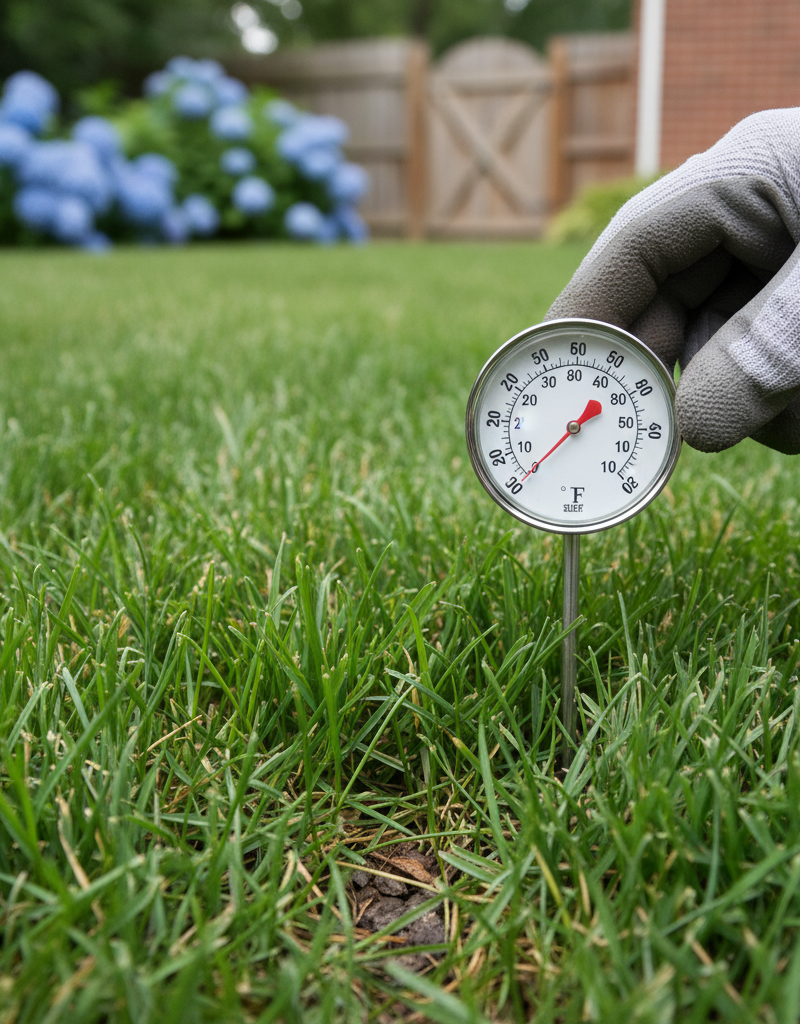
2. Invest in a Soil Thermometer — This is the single most important tool for precise timing. Air temperature is a poor indicator of soil temperature, which lags behind significantly. Look for a basic soil thermometer at your local garden center or online.
- Tool Tip: A simple probe thermometer will suffice. Digital versions can offer quicker readings.
3. Monitor Soil Temperatures Daily — Starting in late winter/early spring (when air temps are consistently above freezing), and again in mid-to-late summer, check your soil temperature daily around midday. Take readings in several spots across your lawn, ideally at a depth of 2-3 inches.
- Consistency is Key: Look for 3-5 consecutive days of target temperatures, not just a single warm day.
4. Select the Right Pre-Emergent — Choose a product specifically formulated for your target weeds. Most general-purpose pre-emergents handle crabgrass effectively. Read the label to confirm its active ingredients (e.g., prodiamine, pendimethalin, dithiopyr) and the types of weeds it controls.
- Safety Note: Always wear gloves, eye protection, and follow all product-specific safety instructions. Keep children and pets off treated areas until dry.
5. Prepare Your Lawn — Before application, your lawn should be free of excessive leaf litter and debris. Shorten your grass to its regular mowing height. A light watering 1-2 days before can help the granules settle, but don't apply to a waterlogged lawn.
- If this doesn't work: Ensure your spreader is calibrated correctly according to the product label. Uneven application will lead to uneven weed control.
6. Apply Evenly — Use a broadcast or drop spreader for consistent coverage. Walk at a steady pace and overlap slightly to avoid misses. For granular products, it's often recommended to apply half the material in one direction (e.g., north-south) and the other half perpendicular (e.g., east-west) to ensure uniformity.
- Spreader Calibration: Consult your spreader's manual and the pre-emergent product label for exact settings. An uncalibrated spreader is a common cause of failure.
7. Water It In (Lightly) — For granular pre-emergents, a light watering immediately after application (typically about 0.25 to 0.5 inches of water) is crucial to move the chemical barrier down into the soil where weed seeds germinate. Check the product label for specific watering instructions.
- Warning: Do not overwater, as this can dilute the product or move it too deep, reducing its effectiveness.
8. Mark Your Calendar for the Second Application — Most pre-emergents offer 2-4 months of control. To manage weeds (like new crabgrass flushes) that germinate later in the season or to prepare for fall/winter annuals, a second application might be necessary. Monitor soil temperatures again in mid-summer for fall applications (when temps consistently drop to 70°F). Follow label instructions on reapplication intervals.
- Pro Tip: Never exceed the maximum annual application rate listed on the product label.
Common Causes
- Applying Too Early: The pre-emergent breaks down or is washed away before peak weed germination, leaving your lawn unprotected when seeds are most active. You might see early weed flushes.
- Applying Too Late: Weed seeds have already germinated and begun to sprout. Pre-emergents do not kill existing weeds, only prevent germination after their initial growth. You'll see weeds emerge shortly after application.
- Not Monitoring Soil Temperature: Relying solely on ambient air temperature or a calendar date is imprecise. Soil temperature is the primary trigger for most weed seed germination.
- Improper Spreader Calibration: Applying too little product results in an ineffective barrier, while applying too much can harm desirable turfgrass.
- Not Watering In Granular Products: Granular pre-emergents need to be watered into the soil to activate the chemical barrier. Without water, they sit on the surface, exposed to degradation.
- Applying to an Unprepared Lawn: Thatch, leaf litter, or dense debris on the lawn surface can prevent the pre-emergent from reaching the soil where it needs to work.
Common Mistakes
- Using Pre-Emergent on Newly Seeded Lawns: Pre-emergents will prevent your desirable grass seeds from germinating too. Wait until new turf is established (at least 2-3 mowings) before applying. Look for
Related Articles
Keep troubleshooting with these hand-picked guides from FixlyGuide:
- The #1 Timing Mistake That Makes Pre-Emergents Useless (And How to Fix It) — Applying pre-emergent weed control at the wrong time is the most common reason for failure, leading to wasted product and persistent weeds.
- The #1 Lawn Aeration Mistake Most Homeowners Make (And How to Fix It) — Timing is everything when it comes to lawn aeration, and doing it at the wrong time can do more harm than good for your grass.
- The #1 Summer Lawn Mistake Turning Your Grass Yellow (and How to Fix It) — Discover the most common summer lawn mistake that causes yellowing grass and learn the simple steps to revive your lawn.
- The #1 Summer Lawn Mistake That Guarantees Yellow Grass (It's Not Drought) — Understanding the most common mistake homeowners make with summer lawn care can save your grass from turning yellow and dying.
- The #1 Mistake Killing Your Lawn (and How to Remove Clover Without Chemicals) — Discover the most common mistake homeowners make when battling clover and learn effective, organic methods to eliminate it without harming…
- The #1 Mistake That Makes Deck Boards Warp (And the Easy Fix) — Discover the most common reason deck boards warp and how a simple, proactive fix can restore your deck's appearance and longevity.
Frequently asked questions
How do I know when to apply pre-emergent?+
The best way is to monitor your soil temperature. For spring application, apply when soil consistently reaches 50-55°F. For fall, apply when soil temperatures drop to around 70°F.
What happens if I apply pre-emergent too late?+
If applied too late, weed seeds will have already germinated. Pre-emergents only prevent germination, so they will be ineffective against weeds that have already started to grow.
Can I apply pre-emergent and seed my lawn at the same time?+
No, pre-emergents will also prevent your desirable grass seeds from germinating. You must wait until your new grass is established (after at least 2-3 mowings) before applying a pre-emergent.
How soon after applying pre-emergent can it rain?+
For granular products, a light rain (or watering) shortly after application is beneficial to move the product into the soil. However, heavy downpours immediately after can sometimes wash away or dilute the barrier. Always check the product label for specific instructions.

Discussion
Loading comments…