Tools & materials you'll need
Affiliate links- AmazonDrip-Free Caulk Gun1 · A 'drip-free' model helps prevent messes.
- AmazonCaulk Removal Tool1 · The hook-shaped tools are most effective.
- AmazonCaulk Tooling Spatula1 kit · A kit with multiple edge profiles is useful.
- AmazonUtility Knife1 · For cutting old caulk and the caulk tube nozzle.
- AmazonStiff-Bristled Brush1 · A grout brush or old toothbrush works well.
- Amazon100% Silicone Sealant1 tube · Ensure it's rated for kitchens/baths with mold inhibitors.
- AmazonDenatured Alcohol1 bottle · Used as a solvent for final cleaning to remove all residue and moisture.
- AmazonClosed-Cell Backer Rod1 roll · Choose a diameter ~25% larger than your joint width.
- AmazonPainter's Tape1 roll · High-quality tape like FrogTape or 3M Blue is recommended.
- AmazonNitrile Gloves1 pair · To protect hands from silicone and solvents.
As an Amazon Associate FixlyGuide earns from qualifying purchases — at no extra cost to you. Prices and availability are accurate as of publication and subject to change.
Quick Answer
The secret to a 10-year bathroom caulk job is a three-part system: complete removal of old caulk, meticulously cleaning and drying the joint with a solvent like denatured alcohol, and then applying 100% silicone caulk over a properly sized foam backer rod. The backer rod creates the ideal hourglass-shaped seal that adheres to only two sides of the joint, allowing it to flex with temperature changes instead of tearing.
The Problem
It’s a depressingly familiar sight in millions of bathrooms: a cracked, yellowing, or mold-speckled line of caulk bordering the tub or shower. Every year or two, you scrape out the old, failing sealant and lay down a fresh bead, hoping this time it will last. But soon enough, the corners begin to peel, the mildew returns, and the cycle repeats. This isn't just a cosmetic annoyance; that failing strip of bathroom caulk is a critical waterproof barrier. When it fails, it’s an open invitation for water to seep into the wall cavity and subfloor. Even a tiny, hairline crack can wick gallons of water over months, leading to wood rot, delaminating tile, structural decay, and a mold bloom that can cost thousands of dollars in remediation and repairs. The recurring failure isn't your fault—it's the result of a flawed method. Simply squirting a line of caulk into a gap is a temporary patch, not a permanent seal. The real professional solution involves understanding why caulk fails and employing a systematic approach that ensures flexibility, adhesion, and longevity.
How It Works
The fundamental mistake most DIYers make is thinking of caulk as a simple gap filler. Professionals understand that a caulk joint is a dynamic, high-performance seal designed to absorb movement. The area where your tub meets the tile isn't static; it expands and contracts with every temperature change. A hot shower heats the materials, causing them to expand; as they cool, they contract. If the caulk is stuck to the tub, the tile wall, and the back wall of the joint (a condition called "three-point adhesion"), this movement puts immense stress on the bead, tearing it from the side or causing it to split down the middle.
The professional solution ensures "two-point adhesion." The caulk must adhere only to the two primary surfaces (e.g., the tub deck and the tile face), leaving the back of the joint free. This creates an "hourglass" or "U" shape that can flex and stretch like a rubber band. The secret weapon to achieve this is foam backer rod. This inexpensive, flexible foam rope is pressed into the joint before caulking. It acts as a bond-breaker at the back of the joint and ensures you use the correct depth of caulk, preventing three-point adhesion and creating the ideal, flexible shape. Combined with the superior elasticity and waterproofing of 100% silicone bathroom caulk, this system creates a durable, waterproof seal that can withstand years of movement and moisture.
Step-by-Step Fix
This is a game of patience and precision. Rushing the preparation will guarantee failure. Follow these steps exactly for a seal that lasts.
1. Prepare Your Materials — Gather everything before you start. You will need a drip-free caulk gun, a utility knife with a fresh blade, a dedicated caulk removal tool (the hook-shaped kind is best), a stiff-bristled brush, denatured alcohol, a roll of appropriately sized closed-cell foam backer rod, high-quality painter's tape, a professional caulk tooling spatula (do not use your finger), plenty of paper towels, and a tube of 100% silicone bathroom caulk with mold inhibitors.
2. Complete Demolition of Old Caulk — The new seal is only as good as the surface it sticks to. Use the utility knife to carefully slice along the top and bottom edges of the old caulk line. Then, use the caulk removal tool to hook under the bead and pull it out in long strips. Be persistent. Every last bit of old caulk, residue, and soap scum must be mechanically scraped away. There is zero tolerance for old material.
3. The Critical Three-Stage Clean — Once the physical debris is gone, the real cleaning begins. First, use a shop vacuum with a crevice tool to suck out all the fine dust and scraped particles from the joint. Second, don a pair of gloves, pour denatured alcohol onto a clean rag, and aggressively scrub the joint and surrounding surfaces (about an inch out from the joint). Denatured alcohol is a solvent that dissolves remaining residues and, crucially, displaces any water, forcing it to evaporate. It also kills any lingering mold or mildew spores. Unlike water-based cleaners, it leaves no film behind. Finally, wipe the joint one last time with a fresh, dry rag and allow it to air out for at least an hour, though longer is better.
4. Verify the Joint is Bone Dry — This cannot be overstated. Even a hint of moisture trapped under the new caulk will prevent it from adhering properly and can lead to immediate failure. A good test is to touch the surface; it should feel completely neutral, not cool. If in doubt, use a hair dryer on a low setting to gently warm the joint and surrounding tile to be absolutely certain it is 100% dry.
5. Install the Foam Backer Rod — Measure the width of your joint. Select a backer rod that is about 25% larger in diameter than the widest part of the gap. For example, for a 1/4-inch joint, use a 3/8-inch backer rod. Using a blunt tool like a 5-in-1 painter’s tool or the back of your tooling spatula, press the foam rod into the joint to a uniform depth, typically about 1/8-inch below the surface. This creates the void that will form the ideal caulk shape.
6. Create a Perfect Frame with Tape — This is the secret to razor-sharp, professional-looking lines. Apply two parallel strips of high-quality painter's tape, one on the tub deck and one on the tile wall, leaving an even, clean gap for your caulk bead (typically 1/8 to 3/16-inch wide).
7. Prepare and Load the Caulk Tube — Cut the nozzle of the bathroom caulk tube at a 45-degree angle. The size of the opening should be just slightly smaller than the gap you taped off. Use a long nail or the built-in poker on your caulk gun to puncture the inner foil seal. Load the tube into your drip-free caulk gun and give it a gentle squeeze until you see caulk at the tip.
8. Apply the Caulk Bead — Hold the caulk gun at a 45-degree angle to the joint. The key is to push the bead of caulk into the joint, not pull it behind the gun. This forces the caulk down into the gap for a better seal. Move at a slow, steady pace, applying consistent pressure to the trigger. You want to apply enough material to slightly overfill the gap.
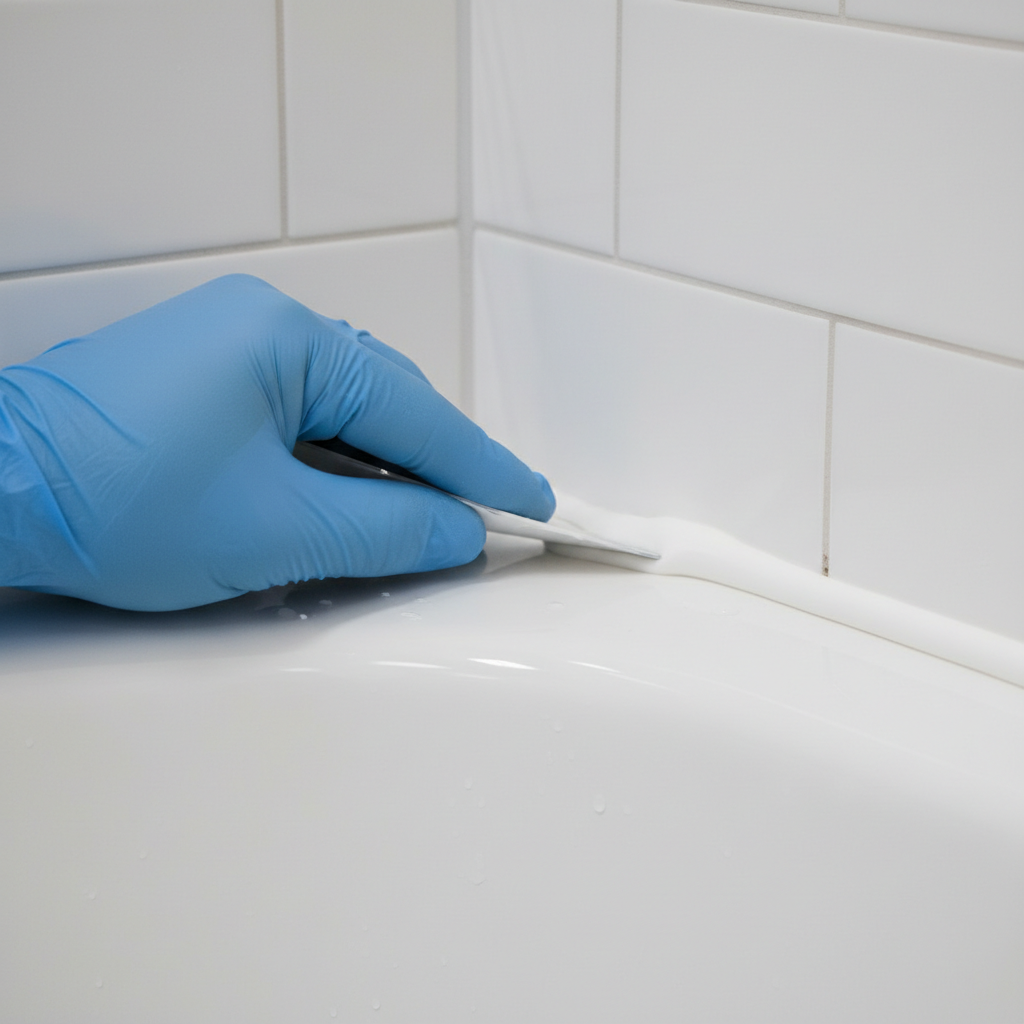
9. Tool the Joint Immediately — Do not use your finger. A wet finger creates a concave surface that pools water and doesn’t properly force the caulk into the corners. Instead, use a professional caulking tool. Press the tool firmly into the corner and pull it along the joint in one smooth, continuous motion. This will press the bathroom caulk firmly against the two surfaces (and the backer rod), creating the ideal hourglass profile while scraping away the excess. Wipe the excess caulk from the tool onto a paper towel after each pass.
10. Immediately Remove the Tape — As soon as you finish tooling, carefully pull the painter's tape off. Pull it slowly, at a 45-degree angle away from the joint. This will leave a perfectly crisp, clean caulk line. If you wait for the caulk to skin over, it can pull up with the tape, ruining your bead.
11. Let It Cure Completely — Patience is a virtue. 100% silicone caulk cures by reacting with moisture in the air. This takes time. Do not touch the caulk or allow it to get wet for at least 24 hours. For the best, most durable results, wait 48-72 hours before using the shower or tub. Using it prematurely will wash away uncured material and compromise the seal.
Common Causes
Understanding why a bathroom caulk job fails is key to preventing a repeat performance.
- Improper Surface Preparation: This is the #1 cause of failure. Any soap scum, oil, dust, or old caulk residue will prevent the new silicone from bonding. Trapped moisture is equally problematic, creating a weak bond and potential for mold growth from within.
- Three-Point Adhesion: As detailed above, when caulk sticks to the back of the joint in addition to the sides, any movement is guaranteed to tear the bead. This is what backer rod specifically prevents.
- Wrong Type of Caulk: Using cheap acrylic latex ("painter's caulk") in a wet area is a fatal error. It is not waterproof, has poor elasticity, and will quickly degrade and grow mold. Even "siliconized" acrylic/latex is an inferior choice for a tub or shower surround.
- Joint Movement Exceeding Caulk Capability: If a home has significant structural settling or the tub is not properly supported, the joint may move more than even high-quality caulk can handle. Look for a caulk that meets ASTM C920 Class 25 or Class 35, meaning it can handle 25% or 35% joint movement, respectively.
- Harsh Chemical Cleaners: Regular use of abrasive powders or bleach-heavy sprays can degrade silicone over time, reducing its lifespan and making it more susceptible to mold.
Common Mistakes
Avoid these frequent DIY pitfalls to ensure your hard work pays off.
- Caulking over old caulk. This never works. The new caulk will not adhere properly to the old, and you are simply sealing over existing mold and grime.
- Using a wet finger to tool the bead. This introduces moisture, creates a concave surface that holds water (promoting mold), and doesn't effectively force the caulk into the joint for a strong bond.
- Failing to use backer rod in joints wider than 1/4 inch. In wider gaps, skipping the backer rod almost guarantees three-point adhesion and premature failure.
- Not allowing adequate cure time. Exposing fresh silicone caulk to water before it has fully cured (24-72 hours depending on the product, humidity, and temperature) will wash away uncured polymers and ruin the seal.
- Choosing caulk based on price. A $4 tube of acrylic latex caulk is a waste of money in the bathroom. Spending $10-$15 on a high-quality 100% silicone caulk is a small investment for a 10-year lifespan.
- Rushing the cleaning step. Most people spend 5 minutes cleaning when they should spend 30. Use a solvent like denatured alcohol, not just a damp rag, to eliminate all residue.
Cost & Time Breakdown
This project is one of the highest-value DIY tasks a homeowner can perform, saving hundreds over a professional job.
| Task | DIY Cost | Pro Cost | Time |
|---|---|---|---|
| Materials & Tools | $25 - $50 | (Included) | 30 min |
| Old Caulk Removal & Joint Prep | $0 | $100 - $175 | 1.5 - 2.5 hours |
| Taping, Application & Tooling | $0 | $100 - $200 | 1 - 1.5 hours |
| Curing (Downtime) | $0 | $0 | 24 - 72 hours |
| TOTAL | $25 - $50 | $200 - $450 | 3-5 hrs + Cure |
Tips & Prevention
Once you have a perfect seal, keep it that way.
- Promote Drying: Use your bathroom's exhaust fan during and for 30 minutes after every shower. Squeegeeing down the tile and tub deck also helps reduce moisture.
- Clean Gently: Clean your caulk regularly with a pH-neutral cleaner or a simple solution of vinegar and water. Avoid abrasive scrubs, harsh powders, and concentrated bleach, which can damage the silicone.
- Annual Inspection: Once a year, closely inspect the caulk lines. Press gently on them to check for soft spots or areas that have pulled away. Catching a small failure early can be fixed with a minor touch-up, preventing a major problem.
- Don't Use It as a Shelf: Avoid placing shampoo bottles and soap directly on the caulk line. Water gets trapped underneath, creating a permanent wet spot that encourages mildew growth.
When to Call a Professional
While re-caulking is a very manageable DIY project, there are times when it’s best to call in a pro. If you remove the old bathroom caulk and find that the wallboard behind it is soft, crumbling, or discolored, you have a bigger problem. This indicates that the leak has been active for some time and has caused water damage to the substrate. Similarly, if the floor near the tub feels spongy or you see water stains on the ceiling below, the issue has progressed beyond a simple caulk job. A professional, such as a tile setter or a general contractor, will need to assess the extent of the rot and structural damage, which may involve removing tile to replace the backer board and repair framing. Ignoring these warning signs will only lead to more extensive and expensive repairs down the road.
Frequently asked questions
What is the absolute best caulk for a shower or bathtub?+
The best caulk is a 100% silicone caulk that meets ASTM C920 Class 25 or 35 standards. These are waterproof, highly flexible, and typically include mildewcides to prevent mold growth. Avoid cheaper acrylic latex or 'siliconized' acrylic caulks for wet areas.
Can I just put a new layer of caulk over the old, cracked caulk?+
No, you should never apply new caulk over old caulk. The new bead will not adhere properly, and it will fail very quickly. You are also trapping old mold and mildew underneath the new layer, which will continue to grow.
How long do I really have to wait before my shower can get wet?+
You should wait a minimum of 24 hours, but 48 to 72 hours is highly recommended for a full, durable cure. The caulk cures by reacting with humidity in the air, and this process takes time. Getting it wet prematurely will compromise the seal.
What is a backer rod and do I really need it?+
A foam backer rod is a flexible foam rope you press into a joint before caulking. For any joint wider than 1/4 inch, it is absolutely essential. It prevents the caulk from sticking to the back of the joint, creating a flexible, two-point seal that won't tear when the joint expands and contracts.
Discussion
Loading comments…