Tools & materials you'll need
Affiliate links- AmazonPressure WasherWith 25-degree and 40-degree fan tips. Keep PSI < 1500.
- AmazonPump-style Garden Sprayer1-2 · Have two if possible: one for cleaners, one for the brightener.
- AmazonOrbital Sander or Pole SanderFor light sanding after the deck is dry.
- AmazonStain Pad Applicator or Wide Stain Brush
- AmazonDeck Stain Stripper (Sodium Hydroxide-based)1-2 gallons · For removing old, failing stain.
- AmazonDeck Cleaner (Sodium Percarbonate-based)1 gallon · For general cleaning and maintenance prep.
- AmazonWood Brightener (Oxalic Acid-based)1 gallon · Crucial for neutralizing pH after cleaning.
- AmazonPenetrating Oil-Based Deck Stain2-3 gallons · Choose a quality semi-transparent or transparent stain.
- Amazon60 or 80-Grit Sandpaper
- AmazonLint-free RagsFor wiping away excess stain.
As an Amazon Associate FixlyGuide earns from qualifying purchases — at no extra cost to you. Prices and availability are accurate as of publication and subject to change.
Quick Answer
Deck stain peels primarily due to improper surface preparation, not the stain itself. The most commonly skipped step is failing to neutralize the wood's pH using a wood brightener after cleaning or stripping. Alkaline cleaners leave the wood with a high pH, which prevents the new stain from properly absorbing and bonding, leading to premature peeling and failure.
The Problem
You spent a weekend—or two—prepping and staining your deck. It looked fantastic for a few months, but now, disaster. The beautiful finish is flaking, peeling, and chipping away, revealing the gray, weathered wood underneath. It looks worse than before you started. This frustrating scenario is incredibly common, and it almost always points back to a failure in preparation, not a faulty product. When deck stain peels, it means the coating failed to achieve a proper bond with the wood fibers. It's sitting on the surface like a coat of paint rather than penetrating deep into the pores as intended. This leaves it vulnerable to moisture, UV rays, and foot traffic, causing it to lift and peel away. The result is a costly and time-consuming mess that you’ll have to strip off completely before you can even think about starting again. Understanding the root cause is the key to preventing a repeat performance.
How It Works
To understand why deck stain peels, we need to look at the anatomy of wood and the chemistry of deck prep. Wood is a natural, porous material filled with microscopic fibers (lignin) and natural oils and tannins. A high-quality semi-transparent or transparent stain is designed to penetrate these pores, bonding with the wood fibers deep within the surface. This is what gives it durability and allows the wood to breathe. A peeling stain is a sign that this penetration never happened.
The most common culprit is a chemical imbalance on the wood's surface, specifically its pH level. To remove old, failing stain or heavy organic growth, homeowners correctly use a deck stripper or a strong deck cleaner. These products are, by necessity, highly alkaline (with a pH of 11-13). They work by aggressively swelling and opening up the wood pores to release the old finish and contaminants. Here’s the problem: if you apply new stain to this highly alkaline surface, it will fail. The open, alkaline-charged pores don't allow the new stain, which is typically neutral or slightly acidic, to absorb correctly. The stain can't bond with the wood fibers and instead just dries on the surface, creating a film that will inevitably peel.
This is where the crucial, most-skipped step comes in: neutralizing the wood with a brightener. Most deck brighteners are acid-based, often containing oxalic, citric, or phosphoric acid. When applied after an alkaline cleaner or stripper, the brightener does two critical things. First, it lowers the wood’s pH from a caustic 11-13 back down to its natural, slightly acidic state (around 6.5-7.5). This returns the wood to a chemically receptive state for staining. Second, it tightens and closes up the wood grain, which might seem counterintuitive, but it actually creates the ideal surface for uniform stain absorption and strong fiber bonding. This simple chemical reset is the secret to a professional-looking, long-lasting deck finish and the #1 reason why a professionally prepped deck outlasts a typical DIY job.
Step-by-Step Fix
Step 1: Inspect and Repair — Before you touch any chemicals, do a thorough inspection. Use a hammer and a screwdriver to probe for soft, rotted boards, paying close attention to the board ends and areas around fasteners. Replace any compromised wood. Hammer down any popped nails or, better yet, replace them with longer deck screws for superior holding power.
Step 2: Choose Your Weapon: Cleaner vs. Stripper — Be honest about your deck's condition. If you're just doing a maintenance coat on a sound finish, a standard "deck wash" (sodium percarbonate) is sufficient. If the old stain is peeling, flaking, or you're changing from a dark to a light color, you absolutely must use a chemical stain stripper (sodium hydroxide-based) to remove the old finish completely. Don't try to stain over a failing coat.
Step 3: Apply the Cleaner or Stripper — Mix the product according to the manufacturer's directions in a pump sprayer. Work in small, manageable sections (e.g., 10x10 feet) to prevent the product from drying out. Lightly mist the section with water, then apply the chemical and let it dwell for the recommended time (usually 15-20 minutes), misting it lightly with water if it starts to dry.
Step 4: Gentle Power Washing — The chemical did the heavy lifting; the power washer is just for rinsing. Use a fan-tip nozzle (a white 40-degree or green 25-degree tip) and keep the pressure set below 1500 PSI. Keep the wand moving and maintain a consistent distance of 12-18 inches from the wood surface to avoid "furring" or permanently damaging the wood fibers. Your goal is to sweep away the old finish, not blast it off with pressure alone.
Step 5: The Crucial Skipped Step: Neutralize & Brighten — This is the game-changer. After rinsing off the stripper/cleaner, the deck is ready for the brightener. While the deck is still wet, apply an oxalic acid-based wood brightener using a clean pump sprayer. You will immediately see the wood’s color lighten and its natural tones return. This step neutralizes the caustic effects of the cleaner, balances the wood's pH, and conditions it for optimal stain absorption.
Step 6: The Final Rinse — Let the brightener dwell for 10-15 minutes as directed by the manufacturer. After the dwell time, give the entire deck a thorough but gentle final rinse with the power washer or a garden hose. You are simply rinsing away the brightener and any remaining residue. Ensure water runs clear and free of suds.
Step 7: Check for Moisture — Patience is a virtue. Staining wood with too much internal moisture is a guaranteed cause of peeling deck stain. Do not rely on how the surface feels. Wait at least 48-72 hours of dry, low-humidity weather. For a foolproof reading, purchase an inexpensive moisture meter and do not apply stain until the reading is below 15% (ideally 12-13%).
Step 8: Sand for a Perfect Finish — Once dry, the cleaning process may have raised the wood grain slightly. For the best possible finish, perform a light sanding using a pole sander or orbital sander with 60 or 80-grit sandpaper. This removes any "wood fuzz," opens the pores just enough, and ensures the stain applies evenly. Vacuum or sweep the dust away thoroughly.
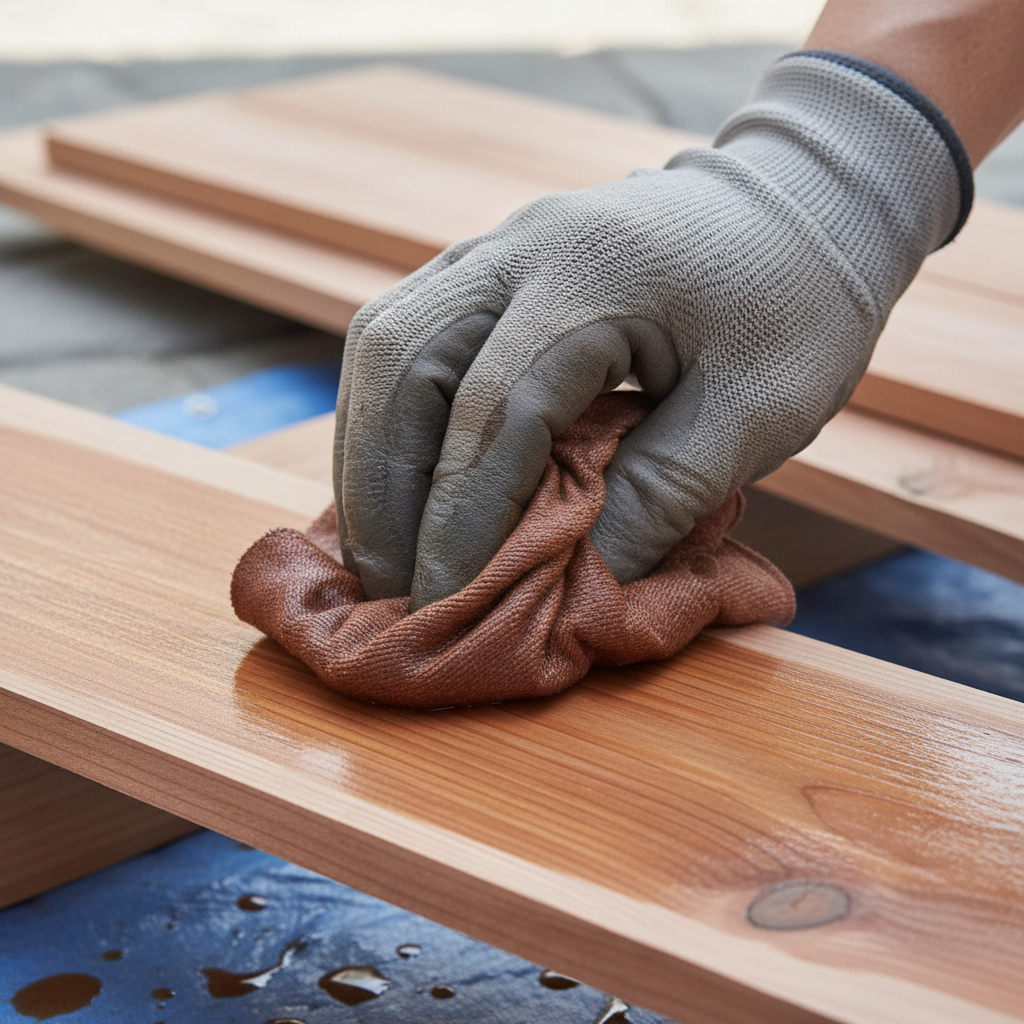
Step 9: Apply the Stain Correctly — Now you're ready. Use a quality stain pad or a wide stain brush. Apply the stain evenly, working on 2-3 boards at a time and maintaining a wet edge to avoid lap marks. Crucially, follow the product instructions regarding how much to apply. For penetrating oil stains, the goal is to apply only as much as the wood can absorb. After a few minutes, wipe away any excess stain that hasn’t soaked in with a clean rag. Puddles or excess stain left on the surface will create a film that will peel.
Common Causes
- Skipping the Wood Brightener: The single biggest cause. Applying stain to high-pH wood after stripping guarantees a weak bond and peeling.
- Staining Damp Wood: Water in the wood pores physically blocks the stain from penetrating. The stain dries on the surface, and as the moisture eventually escapes, it pushes the stain film off.
- Applying a Film-Forming Stain Over a Penetrating Stain: If your deck previously had a penetrating oil-based stain, applying a water-based film-forming (acrylic) stain on top can cause issues. The new stain can't grab the oil-impregnated wood and will likely peel.
- Mill Glaze on New Wood: New lumber often has a hard, shiny surface called "mill glaze" created during the milling process. This glaze seals the pores and must be removed by light sanding and proper cleaning before stain can penetrate.
- Applying Too Much Stain: More is not better. For penetrating stains, any product that doesn't soak into the wood will dry on the surface, creating a weak film that is destined to peel. This is the cause of a sticky or tacky deck that never seems to dry.
- Poor Weather Conditions: Staining in direct, hot sunlight can cause the stain to flash-dry before it can penetrate. Staining in temperatures that are too cold or with high humidity can also dramatically slow curing time and affect the final bond.
Common Mistakes
- Mistake 1: Power Washing with Too Much Pressure. Using a red zero-degree nozzle or holding the tip too close to the wood. This permanently shreds the wood fibers, creating a fuzzy, spongy surface that absorbs stain unevenly and degrades quickly.
- Mistake 2: Staining Over an Old, Failing Finish. Believing that a new coat of stain will fix an old, peeling one. The new stain will adhere to the failing stain, not the wood, and will peel off right along with it within a few months.
- Mistake 3: Skipping Sanding. After cleaning, wood fibers are raised. Skipping a light sanding step leaves a rough surface that can lead to uneven stain application and even splinters.
- Mistake 4: Not Wiping Away Excess Stain. Forgetting or neglecting to go back with a rag and wipe up any stain that hasn’t absorbed after 10-20 minutes. This excess product becomes a primary source of peeling.
- Mistake 5: Not Checking the Weather Forecast. Starting a big staining project the day before a predicted rainstorm or during a week of very high humidity. This introduces moisture into the equation at the worst possible time.
- Mistake 6: Using a "Deck Wash and Sealer in One" Product. These all-in-one products promise a shortcut but can
Frequently asked questions
Can I just power wash my deck and then stain it?+
No, this is a common mistake. Power washing alone does not remove all contaminants, mildew, or old sealed stain. More importantly, it doesn't address the wood's pH. Proper preparation requires a three-step process: cleaning/stripping, brightening/neutralizing, and allowing the wood to dry completely before staining.
How long after pressure washing can I stain my deck?+
You must wait for the wood to be completely dry, which typically takes 48-72 hours in good weather (sunny, low humidity). The best way to be certain is to use a moisture meter; the wood's moisture content should be below 15% before you apply any stain.
What's the difference between a deck cleaner and a deck brightener?+
A deck cleaner is alkaline and is used to remove dirt, mildew, and graying. A deck stripper is a stronger alkaline product for removing old stain. A deck brightener, on the other hand, is acidic (usually oxalic acid) and is used *after* the cleaner to neutralize the wood's pH, restore its natural color, and prepare it for optimal stain absorption.
Is it better to brush, roll, or spray deck stain?+
The best method is often a combination. Spraying can be fastest for application, but a brush or stain pad is essential for working the stain into the wood fibers and wiping up excess. This technique, called 'back-brushing' or 'back-padding,' ensures a much more even and durable finish than spraying alone.
Why did my deck stain peel after only one year?+
If your deck stain peels after just one year, the cause is almost certainly improper preparation. The most likely reasons are: 1) You did not use a wood brightener to neutralize the pH after cleaning. 2) You applied the stain to damp wood. 3) You applied too much stain and did not wipe away the excess.
Discussion
Loading comments…