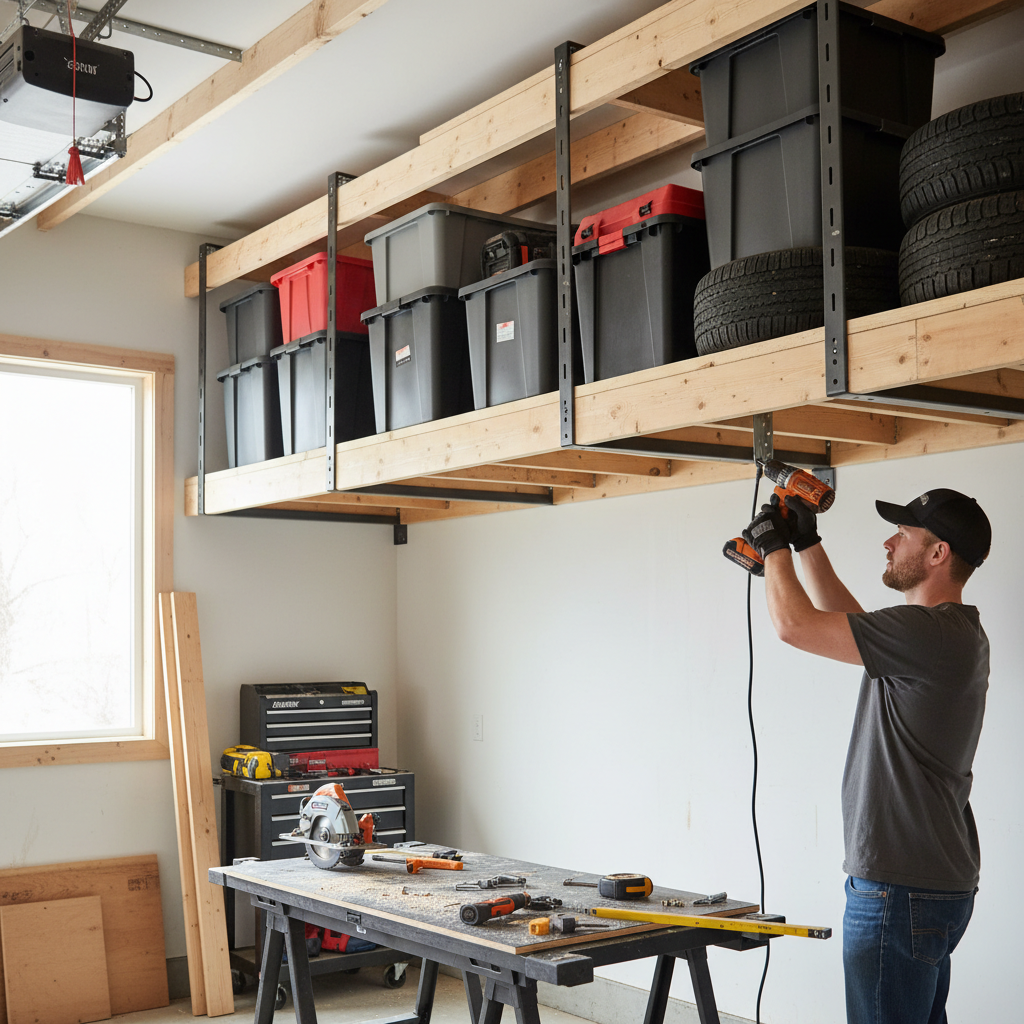
Tools & materials you'll need
Affiliate links- AmazonSafety Glasses1 · Essential for all steps
- AmazonLadder1 · A-frame or extension, tall enough to work comfortably at the ceiling
- AmazonElectronic Stud Finder1 · A high-quality model is recommended
- AmazonPower Drill/Driver1 · For pre-drilling holes and driving screws
- AmazonDrill Bit Set1 · Must include 3/16" bit for pilot holes
- AmazonSocket Wrench Set1 · For tightening lag screws and bolts
- AmazonCircular Saw or Miter Saw1 · For cutting lumber
- AmazonLevel1 · 4-foot level is ideal
- AmazonTape Measure1 · 25-foot tape
- AmazonC-Clamps2 · For temporarily holding the frame during assembly
No materials required.
As an Amazon Associate FixlyGuide earns from qualifying purchases — at no extra cost to you. Prices and availability are accurate as of publication and subject to change.
Quick Answer
To safely build garage overhead storage that holds 400 pounds, you must distribute the weight across multiple ceiling joists. This is achieved by first bolting 2x6 ledger boards perpendicular to the joists with 3/8" lag screws. From these ledgers, you hang a sturdy 2x4 and plywood platform. This method prevents overloading any single joist and avoids catastrophic failure.
The Problem
For most homeowners, the garage is a black hole of clutter. Bicycles, holiday decorations, seasonal equipment, and countless bins devour floor space, leaving little room for the very vehicles the garage was designed to protect. You look up and see a vast, empty expanse—the ceiling. The potential is obvious, but the execution is fraught with danger. A poorly designed or installed garage overhead storage unit is a ticking time bomb. Many homeowners make the critical mistake of attaching hangers directly into a single joist or, even worse, just the drywall. A single 2x-joist is not designed to handle a 400-pound point load, plus the weight of the shelf itself. This can lead to sagging, cracking, and eventual catastrophic failure, dropping hundreds of pounds of gear onto your car, or worse, a person. The core problem isn't just about building a shelf; it’s about engineering a system that safely transfers a heavy load from the shelf, to its supports, and across the fundamental structure of your home without causing damage or creating a hazard.
How It Works
Understanding why this system is safe requires a basic grasp of structural physics. The secret lies in one principle: load distribution. Imagine hanging a 400-pound weight from a single hook in your ceiling—all that force is concentrated on one small point, stressing a single joist and its fasteners. Now, imagine hanging that same weight from a wide steel plate held up by four hooks. Each hook now only carries 100 pounds. Our design accomplishes the same thing using lumber.
The 2x6 ledger boards are the "steel plate" in this analogy. By mounting them perpendicular to the direction your ceiling joists run, you create a bridge. When you secure the ledger to each joist it crosses with a heavy-duty lag screw, you are creating multiple anchor points. The total weight of your storage platform and its contents is first transferred up the vertical 2x4 supports. From there, the load moves into the 2x6 ledger boards. The ledgers then distribute that entire load across all the ceiling joists they are attached to—typically four or five for an 8-foot-long ledger. Instead of one joist struggling to hold 400 pounds, five joists might each hold just 80 pounds, a load they can easily bear. Pre-drilling for the lag screws ensures the wood doesn’t split, and using washers prevents the bolt head from pulling through the ledger over time. This transforms a dangerous point load into a safe, distributed load.
Step-by-Step Fix
SAFETY NOTE: You will be working on a ladder and lifting heavy objects. Always have a helper. Wear safety glasses and gloves throughout this process. Ensure your ladder is stable and in good condition.
-
Plan and Design Your Platform: Decide on the dimensions. A 4x8-foot platform is efficient as it matches a standard sheet of plywood. Measure your ceiling area, ensuring the planned location won't interfere with garage door operation, overhead lights, or attic access. Note the direction your ceiling joists run.
-
Locate and Mark Ceiling Joists: Use a high-quality electronic stud finder to locate the joists in your chosen area. Mark both edges of each joist, then find and mark the center. Your ledger boards will run perpendicular to these joists. Mark a level guideline for where the bottom of the ledgers will sit.
-
Install the Ceiling Ledgers: Cut two 2x6 boards to the desired length of your platform (e.g., 8 feet). Position the first ledger against the ceiling, aligned with your level line. Pre-drill a 3/16-inch pilot hole through the ledger and into the center of each joist it crosses. Secure the ledger to the joists using a 3/8" x 3.5" lag screw with a washer for each hole. Use a socket wrench to tighten the screws until they are snug, but do not overtighten to the point of stripping the wood. Repeat for the second ledger, ensuring it is parallel to the first and spaced correctly for the platform's width (e.g., 4 feet apart, outside edge to outside edge).
-
Construct the Platform Frame: On the garage floor, build a rectangular frame from 2x4s to your desired dimensions (e.g., 4x8 feet). For an 8-foot frame, you'll have two 8-foot boards and two 45-inch boards (48" minus the 2x 1.5" thickness of the side boards). Use two 3-inch construction screws at each corner. For a platform this large, install a center support joist in the middle of the frame (cut to 45 inches) to prevent the plywood decking from sagging.
-
Cut and Attach Vertical Supports: Determine the desired height for your storage. Cut four 2x4s to serve as vertical hangers. The length should be your desired drop height plus the height of the platform frame (3.5 inches). Attach these vertical supports to the inside of the ceiling ledgers, one near each corner. Use two 3/8" x 3.5" carriage bolts with nuts and washers for each support for maximum strength. Drill the holes through both the support and the ledger and bolt them together securely.
-
Lift and Secure the Platform Frame: This is a two-person job. Lift the 2x4 frame you built and position it so it rests on the bottom of the vertical supports. Use C-clamps to temporarily hold the frame securely in place against the supports.
-
Bolt the Frame to the Supports: With the frame clamped, drill two 3/8-inch holes through each corner where the frame and vertical supports meet. Secure the frame to the supports using 3/8" x 3.5" carriage bolts with washers and nuts. Once all bolts are tight, you can remove the clamps. Your core structure is now complete and should be extremely rigid.
-
Install the Plywood Decking: Place a sheet of 3/4-inch plywood on top of the secured frame. This is the floor of your storage platform. Use 1 5/8-inch construction screws to fasten the plywood to the 2x4 frame every 8-10 inches around the perimeter and into the center support joist.
-
Add a Safety Lip (Recommended): Cut 2x4s to create a small rim or "lip" around the top edge of the platform. This prevents bins and other items from accidentally sliding off. Screw this lip into the platform frame from the outside.
-
Load and Monitor: Begin loading the platform, placing heavier items closer to the ledger boards and distributing the weight as evenly as possible. Listen for any unusual noises and visually inspect the structure to ensure there is no sagging or pulling. Do not exceed your 400-pound target without consulting a structural engineer.
Common Causes of Failure
- Attaching to Drywall Only: Screws into drywall have virtually zero holding power for heavy loads and will pull out immediately.
- Missing the Joist Center: Driving a lag screw into the edge of a joist provides little grip and can split the wood, compromising its strength.
- Using Inadequate Fasteners: Using deck screws or wood screws instead of thick lag screws or bolts for structural connections is a primary cause of failure. These screws are brittle and can shear off under load.
- Overloading a Single Joist: Hanging the entire apparatus from a single joist concentrates the entire load, which can damage the joist and ceiling structure.
- Ignoring the Structure's Own Weight: A heavy-duty shelf can weigh 100-150 pounds on its own. This must be factored into the total load on the ceiling joists.
Common Mistakes to Avoid
- Not Pre-Drilling: Driving large lag screws directly into joists can split the wood, severely weakening the anchor point. The pilot hole must be slightly smaller than the screw's shank.
- Working Alone: This project involves lifting a large, heavy frame overhead. It is unsafe to attempt without at least one helper.
- Forgetting Garage Door Clearance: Failing to measure the full travel path of your garage door (including the curved transition) can lead to a collision that damages the door, opener, or your new shelf.
- Using Low-Quality Lumber: Avoid using warped boards or wood with large knots, as these defects create weak points in the structure.
- Not Using Washers: Washers are critical for preventing lag screw and bolt heads from sinking into the wood over time under load, which can lead to a loose connection.
- Guessing on Joist Location: A cheap stud finder can be unreliable. Use a high-quality model and make several passes to confirm the exact center of each joist before drilling.
Cost & Time Breakdown
This breakdown assumes a 4x8-foot platform. Prices are estimates and can vary by location.
| Item | Purpose | Estimated Cost |
|---|---|---|
| Lumber & Plywood | Structure and Decking | $120 - $180 |
| Lag Screws & Bolts | Fastening to Ceiling/Frame | $30 - $50 |
| Construction Screws | Frame & Decking Assembly | $10 - $15 |
| Total DIY Cost | (Materials Only) | $160 - $245 |
| Professional Install | Labor and Materials | $600 - $1,000+ |
Tips & Prevention
- Paint for Protection: Prime and paint all lumber before installation. This protects the wood from moisture and gives your garage overhead storage a clean, finished look.
- Label Everything: Use a marker to clearly label the contents of opaque storage bins. This prevents you from having to dangerously shift heavy bins to find what you need.
- Distribute Weight Wisely: Always place the heaviest items toward the sides of the platform, directly over the vertical supports, and spread the load as evenly as possible.
- Periodic Inspections: Once or twice a year, get on a ladder and visually inspect all the connections. Check that all nuts and lag screws are still tight and that there are no signs of wood splitting or stress.
- Mind the Edges: In addition to a safety lip, always store items a few inches back from the edge of the platform to reduce the risk of something falling due to vibrations from the garage door opener.
- Use Quality Bins: Invest in heavy-duty plastic storage bins with secure lids that stack well. This keeps contents protected and allows for more stable and organized storage.
When to Call a Professional
Building robust overhead storage is a serious undertaking. You should call a professional carpenter or a specialized garage installation company if you encounter any of the following:
- You are not 100% confident in your ability to locate joists and assess their condition.
- Your ceiling is constructed with engineered trusses instead of traditional joists. Trusses are complex, engineered systems, and improperly drilling into or hanging weight from them can compromise the structural integrity of your entire roof.
- You are uncomfortable working on a ladder, lifting over 50 pounds overhead, or accurately using the required power tools.
- Your ceiling is unusually high (over 12 feet), which increases the risk and complexity of the installation.
- You have any doubt whatsoever about the process. The potential consequences of a failed installation—costly property damage and severe personal injury—are not worth the risk. A professional guarantees the work is done safely and is structurally sound.
Related Articles
Keep troubleshooting with these hand-picked guides from FixlyGuide:
- Your Floating Shelves Failed? 3 Hidden Drywall Mistakes. — Learn how to safely and securely install floating shelves into drywall using the right anchors and tools, avoiding common mistakes.
- The $150 Upgrade Hiding 2x More Pantry Space — Stop losing items in the back of your pantry; learn the expert method for installing pull-out shelves to maximize storage and accessibility…
- The Giant Drywall Hole: 3 Hidden Mistakes That Make Fixing It Worse — Don’t just spackle over that huge drywall hole; learn the right way to repair it and avoid common mistakes that lead to an even bigger head…
- The Giant Drywall Hole: 3 Hidden Causes (And The Best Permanent Fix) — Don’t just slap a patch on a large drywall hole—understand the common causes and learn the most durable repair method homeowners can tackle.
- Your Floating Shelves Sag? The 3 Drywall Mistakes You're Making — Learn how to install floating shelves into drywall securely and prevent common issues like wobbling or damage with the right tools and tech…
- The Hidden Reason Your GFCI Won't Reset (And It's Not Always a Short) — Uncover the mysterious reasons your GFCI outlet refuses to reset and learn the exact steps to diagnose and fix the problem safely, preventi…
Get the print-ready PDF of this guide
A clean, ad-free, printable version you can keep on your phone or pin to the workshop wall. We'll also send occasional weekly tips matched to your home situation.
- Print-optimized layout
- Tools, materials & every step included
- Unsubscribe anytime
Frequently asked questions
Can I hang storage from engineered roof trusses?+
It is strongly advised not to hang significant weight from roof trusses without consulting a structural engineer. Trusses are designed to distribute roof loads to exterior walls, and altering or point-loading them can compromise your home's structure.
What is the best material for the storage platform deck?+
For heavy-duty applications, 3/4-inch CDX plywood is the gold standard. It provides excellent strength and rigidity to prevent sagging between supports. Oriented Strand Board (OSB) can be used, but it is more susceptible to moisture and may sag more over time.
How much weight can a single garage joist hold?+
This varies greatly based on the joist's size (2x6, 2x8, etc.), wood species, span, and spacing. There is no single answer, which is precisely why you should never hang a heavy storage platform from a single joist. The method described in this article distributes the load, making it safe.
Is it better to use bolts or lag screws for the vertical supports?+
Through-bolting with carriage bolts, washers, and nuts provides the strongest connection. Lag screws are acceptable if they are sufficiently long and thick (e.g., 3/8" x 3.5"), but a bolted connection is mechanically superior for shear and tension forces.
Discussion
Loading comments…