Tools & materials you'll need
Affiliate linksAs an Amazon Associate FixlyGuide earns from qualifying purchases — at no extra cost to you. Prices and availability are accurate as of publication and subject to change.
Quick Answer
When your air conditioner starts blowing warm air, the most common culprit is a failed start/run capacitor in the outdoor condenser unit. This cylindrical component is vital for providing the electrical kick needed to start both the compressor and the condenser fan motor. If your outdoor unit is making a humming sound but the fan isn't spinning and cold air isn't coming through your vents, a faulty capacitor is highly likely. Replacing it is a straightforward DIY task that can save you a service call fee.
The Problem
You're sweating, your thermostat is set to 'cool,' but only warm, stale air is wafting from your vents. Your outdoor AC unit, also known as the condenser, might be making a low hum, but the large fan on top isn't spinning. Or perhaps the compressor, which is the heart of the cooling system, isn't engaging. This lack of proper operation in the outdoor unit means the refrigerant isn't circulating and exchanging heat as it should, resulting in no cooling for your home. Before you panic and call an HVAC technician, understanding the role of a small, often overlooked component can save you time and money.
How It Works
Your air conditioning system operates on a simple principle: moving heat from inside your home to the outside. This is achieved through a closed-loop refrigerant cycle. The indoor unit (evaporator coil) absorbs heat from your home's air, turning the liquid refrigerant into a gas. This warm, low-pressure gas then travels to the outdoor unit (condenser). Here, the compressor, a powerful pump, pressurizes and heats the refrigerant gas. This high-pressure, hot gas then flows through the condenser coil, where the condenser fan pulls outside air over the coil, allowing the refrigerant to release its heat to the environment and condense back into a high-pressure liquid.
For this entire process to work, the compressor and the condenser fan motor need a significant surge of electricity to start. This is where the capacitor comes in. A capacitor stores electrical energy and releases it quickly to provide the initial torque needed to get these motors spinning. Think of it like a jolt of energy. There are typically two types: a start capacitor, providing a quick burst for a few seconds, and a run capacitor, which helps maintain efficiency once the motor is running. Many AC units use a dual-run capacitor, which has three terminals and serves both the compressor and the fan motor. Without a functioning capacitor, the compressor won't pump refrigerant, and the fan won't dissipate heat, causing your AC to blow warm air and potentially damaging other components.
Step-by-Step Fix
Safety First — Before attempting any work on your AC unit, always turn off the power at the thermostat and at the main electrical breaker for the outdoor unit. This typically involves a dedicated breaker in your electrical panel, often labeled 'AC' or 'Condenser.' You should also pull the disconnect switch located near the outdoor unit.
-
Identify the Symptoms — Confirm that your indoor unit is running (blower fan is on, thermostat is calling for cooling) but the outdoor unit's fan isn't spinning, or the compressor isn't humming. You might hear a distinct clicking or a low hum from the outdoor unit as it attempts to start without success. This is a common indicator of a bad capacitor.
-
Power Down — Crucially, shut off all power to the outdoor unit. Switch off the thermostat, then locate the electrical disconnect switch near the unit and pull the handle or flip the switch to the OFF position. Finally, turn off the dedicated AC breaker in your main electrical panel. Always verify the power is off with a non-contact voltage tester before touching any components.
-
Locate the Capacitor — Remove the access panel on the side of your outdoor condenser unit. It's usually a small metal panel secured by a few screws. The capacitor is a cylindrical component, typically silver or black, ranging in size from a soda can to a small energy drink can. It will have several wires connected to its terminals.
- If you can't find it: Consult your unit's owner's manual or look for wiring diagrams usually pasted inside the access panel.
-
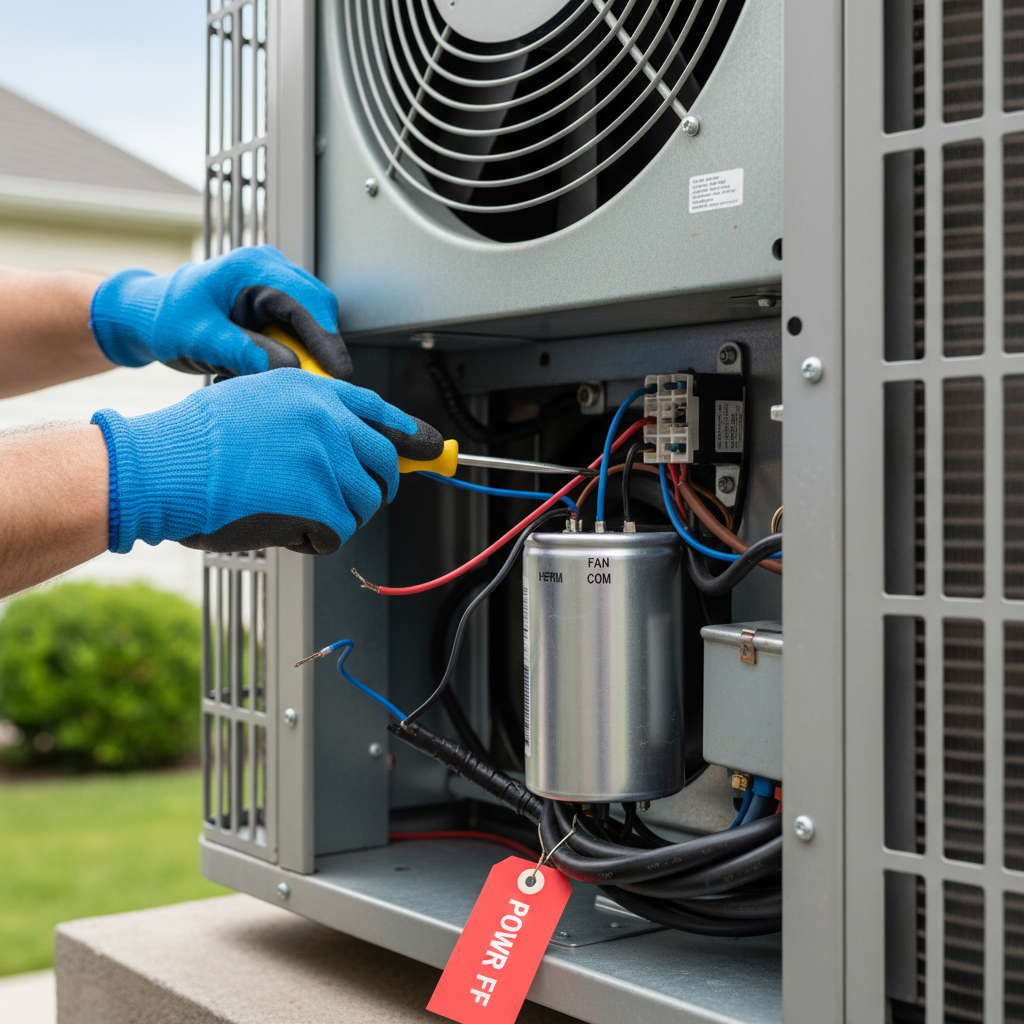
Discharge the Capacitor — Even with the power off, a capacitor can store a dangerous electrical charge. This step is critical for your safety. Using a screwdriver with an insulated handle, short out the terminals by placing the metal shaft across two terminals simultaneously. Repeat this for all pairs of terminals until you hear no spark or just a very small one. Some technicians use a resistor for a slower, safer discharge, but a screwdriver is common for DIYers. Wear electrical-rated gloves and safety glasses.
- Safety Note: If you are uncomfortable with this step, please call a professional.
-
Note Wiring Configuration — Before disconnecting any wires, take a clear photo of the capacitor and its wiring. Pay close attention to which colored wire goes to which terminal (e.g., 'C' for common, 'HERM' for compressor, 'FAN' for fan motor). If it's a dual-run capacitor, it will have three terminals, sometimes labeled 'C', 'HERM', and 'FAN'.
-
Remove the Old Capacitor — Carefully disconnect the wires from the terminals. Note that some wires might be tight. You might need needle-nose pliers. Once disconnected, unfasten the old capacitor from its clamp or mounting bracket.
-
Read the Specifications — Capacitors have microfarad (µF or MFD) ratings and voltage ratings printed on their side (e.g., 45/5 µF, 370/440 VAC). The microfarad rating must match your old capacitor exactly. The voltage rating can be the same or higher (e.g., if yours is 370 VAC, a 440 VAC replacement is fine, but not lower). If it's a dual capacitor, match both µF ratings (e.g., 45/5).
- Tip: A swollen top on the capacitor is a clear sign of failure, but they can fail internally without visible signs.
-
Install the New Capacitor — Connect the wires to the corresponding terminals on the new capacitor, referencing your photo. Ensure all connections are snug. Secure the new capacitor in its mounting bracket. Double-check that all wires are correctly attached according to your picture.
-
Restore Power and Test — Replace the access panel. Reinsert the disconnect switch (or flip the breaker back on) and turn the main AC breaker back on. Set your thermostat to a low-temperature setting to call for cooling. Go outside and observe the outdoor unit. The fan should engage and spin freely, and you should hear the compressor humming smoothly. If it works, enjoy the cool air!
- If it doesn't work: Ensure all connections are secure. If the fan spins but the compressor doesn't start, or vice-versa, recheck your wiring. If still no success, the issue might be elsewhere (e.g., fan motor, compressor, or a control board), and it's time to call a pro.
Common Causes
Capacitors fail for several reasons:
- Heat: Prolonged exposure to high operating temperatures is the primary cause of degradation.
- Age: Like any electronic component, capacitors have a lifespan, typically 10-15 years, but they can fail much sooner.
- Voltage Spikes: Lightning strikes or power surges can instantly damage a capacitor.
- Overload: If the compressor or fan motor is struggling to start due to other issues, it can put excessive strain on the capacitor.
- Manufacturing Defects: Occasionally, a capacitor may simply be faulty from the factory.
Common Mistakes
- Forgetting to Kill the Power: Working on a live AC unit is extremely dangerous and can lead to severe electrical shock. Always, always, always cut power at multiple points.
- Not Discharging the Capacitor: Even after power is off, capacitors retain a lethal charge. Skipping the discharge step is a serious safety hazard.
- Selecting the Wrong Replacement: Using a capacitor with incorrect microfarad (µF) ratings or a lower voltage rating can cause immediate failure or damage to your compressor or fan motor. Always match the µF exactly and ensure the voltage is equal to or higher than the original.
- Incorrect Wiring: Swapping the 'HERM' and 'FAN' wires on a dual-run capacitor will prevent the unit from operating correctly, potentially damaging the components.
- Touching Terminals Immediately: Assuming the capacitor is discharged after cutting power is a dangerous mistake. Always manually discharge it.
Cost & Time Breakdown
| Task | DIY Cost | Pro Cost | Time |
|---|---|---|---|
| New AC Capacitor | $15–$50 | Included | 15–30 minutes |
| Professional Service Call | N/A | $150–$300 | 1–2 hours |
| Diagnostic Fee | N/A | $75–$150 (often waived if repair performed) | 30 minutes |
| Total DIY Cost | $15–$50 | 20–40 minutes | |
| Total Pro Cost | $150–$450+ | 1–2 hours |
Tips & Prevention
- Annual Inspection: Have your AC unit professionally inspected annually. A technician can test your capacitor's health using a multimeter, often catching a weakening capacitor before it completely fails.
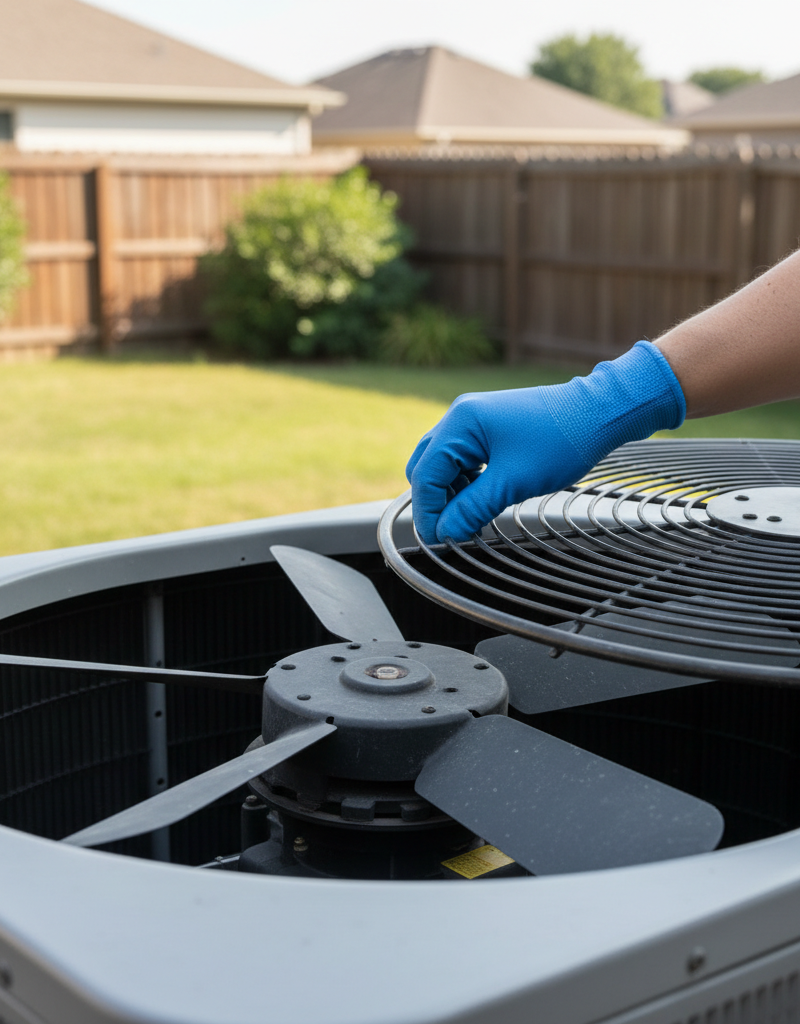
- Clear Debris: Keep the area around your outdoor unit clear of leaves, grass clippings, and other debris. This ensures proper airflow, preventing the unit from overheating and reducing strain on components like the capacitor.
- Shade the Unit: If possible, plant shrubs or build a small overhang to shade your outdoor unit from direct afternoon sun. A cooler operating temperature can extend the life of all components, including the capacitor.
- Listen for Warning Signs: Pay attention to unusual humming, clicking, or rattling sounds coming from your outdoor unit. These can indicate a failing component or a motor struggling to start.
- Consider a Surge Protector: Whole-home surge protectors can offer some protection against voltage spikes that can damage sensitive AC components.
When to Call a Professional
While replacing a capacitor is a manageable DIY task for many homeowners, there are clear instances when you should absolutely call a licensed HVAC professional. If, after replacing the capacitor, your unit still fails to operate correctly, or if you hear grinding, squealing, or extremely loud banging noises, it indicates a more serious underlying issue with the compressor or fan motor. Any refrigerant leaks (identified by oily residue or a hissing sound) require immediate professional attention due to environmental and safety concerns. Furthermore, if you are uncomfortable identifying or discharging the capacitor, lack the necessary tools, or suspect the issue involves electrical wiring beyond simple component replacement, it is always safer and wiser to enlist the expertise of a professional to prevent further damage or injury.
Frequently asked questions
How do I know if my AC capacitor is bad?+
Common signs of a bad AC capacitor include the outdoor unit fan not spinning despite the unit humming, the compressor not running, or the unit repeatedly trying to start and then shutting off. Sometimes, a visibly swollen or bulging capacitor top is also an indicator.
Can I replace an AC capacitor myself?+
Yes, replacing an AC capacitor is a common DIY fix for homeowners comfortable with basic electrical safety and using tools. It involves turning off power, discharging the old capacitor, noting wiring, and installing a new one with matching specifications. However, always prioritize safety and call a professional if unsure.
What happens if I put the wrong capacitor in my AC?+
Using a capacitor with the wrong microfarad (µF) rating or a lower voltage rating can cause serious damage to your AC unit's compressor or fan motor. Incorrect µF can lead to overheating and premature motor failure, while an insufficient voltage rating can cause the capacitor itself to fail quickly or even explode. Always match the µF exactly and use a voltage rating equal to or higher than the original.
How long do AC capacitors last?+
AC capacitors typically last between 10 to 15 years, but their lifespan can vary significantly depending on factors like operating temperature, frequency of use, power surges, and manufacturing quality. They can sometimes fail in as little as 3-5 years under harsh conditions.
Discussion
Loading comments…